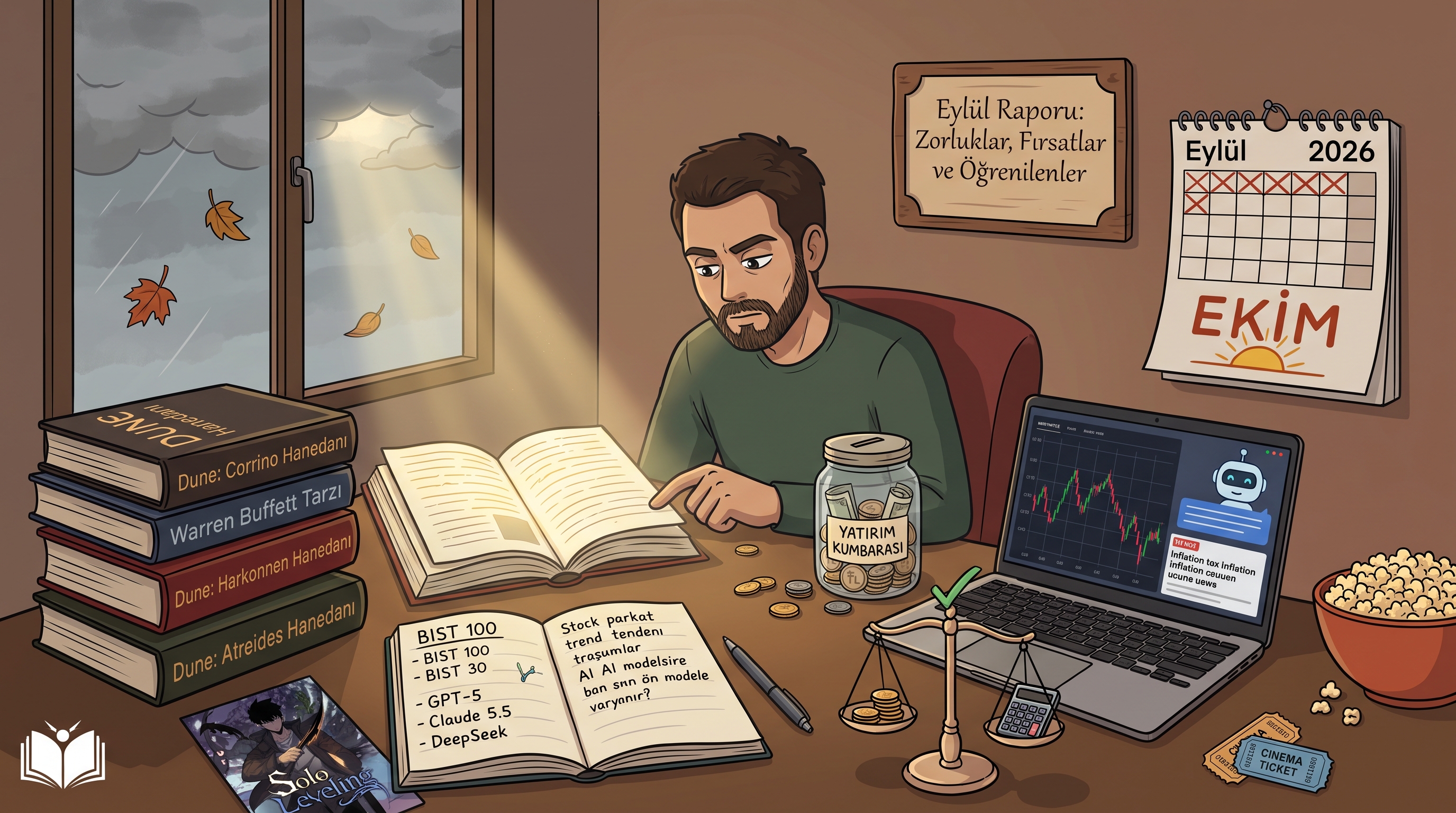
Every month, I want to keep a record of my notes covering finance, technology, and my personal life. My goal is to track the major developments and projects I worked on throughout the month. That way, these posts will serve as a monthly journal of sorts for me.
Let’s kick off this month’s review with financial developments.
Financial Developments
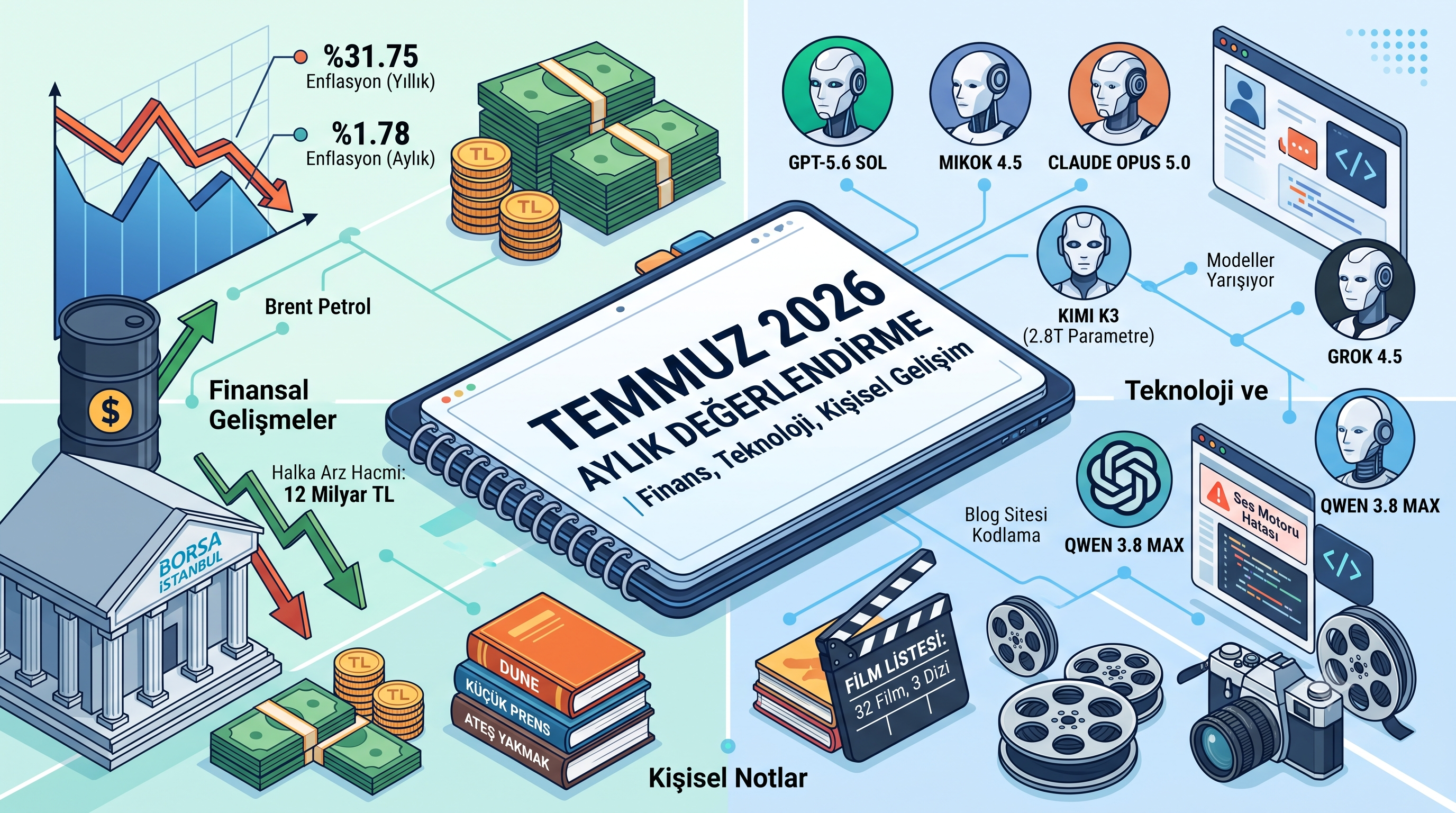
Since I am writing this post a bit late, some of the data for July was released at the beginning of August. According to the announced figures, annual inflation came in at 31.75%, while monthly inflation landed at 1.78%. These figures were announced on August 3. Meanwhile, the PMI index rose from 47.1 to 47.7. The fact that the index remains below 50 indicates that economic contraction is ongoing. Nevertheless, nearing 47.7—essentially approaching 48—can be interpreted as a signal of a bottoming-out process. What’s more, this improvement occurred even before any interest rate cuts were implemented.
The Impact of Oil Prices and War
With the conflict between Iran and America flaring up again, Brent crude oil prices climbed back to the $100 level. Rising oil prices drive up energy costs both globally and in Turkey, creating inflationary pressure. This surge in energy costs also dealt a heavy blow to Borsa Istanbul. The BIST 100 closed the month down 4.7%, continuously losing volume throughout July to finish at 13,458.
The Impact of IPOs on the Market
In July, total IPO volume exceeded 12 billion TRY. If I recall correctly, this might be one of the highest single-month IPO volumes in Turkey’s history. While there may have been months with a higher number of listings, the public offerings of major companies this time drew a substantial amount of cash out of the market. One of the recent planned listings, Bewen Enerji, had to be postponed. I find this unfortunate because I believe the IPO was planned to help clean up the company’s balance sheet, and I suspect both the business and its employees could be negatively affected by this delay.
In short, if IPOs continue at this rate, they could further drain market liquidity and pull the stock market down even lower. Combined with delayed interest rate cuts and light trading volume, expecting Borsa Istanbul to merely hold its current levels—at best—would be a fairly realistic assessment.
My Expectations for Borsa Istanbul
When evaluating the stock market and financial landscape overall, I lean toward the view that the rally or economic acceleration expected for the second half of 2026 has evaporated due to the inflationary impact of energy costs. At best, I expect the Turkish economy to start regaining momentum around the second quarter of 2027. Consequently, I don’t foresee a sustained bull rally or the index moving decisively above the 14,000–15,000 level before then.
However, since markets don’t always move with complete rationality, buying could begin earlier. As the old adage goes, markets buy expectations and sell facts. Therefore, a rally might be seen well before a full economic recovery takes shape. What I mean is this: I believe current market valuations are cheap for the stock market. Looking on a company-by-company basis, there are businesses trading at remarkably discounted levels. Some companies have managed to boost their profitability even during this period. With potential currency depreciation and rising demand, I expect these companies to expand their earnings even further. If the right companies and right valuations can be identified, their returns could far outpace Borsa Istanbul’s returns on an index basis.
Technology and AI Agenda
On the tech side, there aren’t many developments that stuck with me this month, nor was I able to follow the news as closely as I wanted. The tech world can generally be tracked through Apple, Nvidia, AI, RAM dynamics, and innovations coming out of China. China is making serious strides, especially in the space sector. Over time, I think it has the potential to not only catch up with America but surpass it. Similarly, China is making quite successful breakthroughs in artificial intelligence.
The GLM 5.2 model was released in June, and in my view, it proved to be a genuinely successful model. On the ChatGPT front, GPT-5.6 Sol came out. As with the Claude models, different naming conventions like Sol, Terra, and Luna were used here. These names stem from the Sun, Earth, and Moon theme, and model capabilities are designated according to this ranking. On the Claude side, Opus 5.0 was released. Fable 5.0 had been more successful than Opus 4.8, but with Opus 5.0, Opus has once again overtaken Fable. As I recall, Opus 5.0 is a superior model in terms of both cost efficiency and benchmark results. The Mythos model remains behind closed doors and hasn’t been opened to general use yet, but I feel Opus 5.0 has come quite close to Mythos-level capability.
One of the biggest developments of the month was experiencing a second “DeepSeek effect” with the release of the Kimi K3 model. The model was upgraded from Kimi K2.6 to Kimi K3, and I think this update was large enough to fully justify jumping to a whole new version number. Kimi K3 boasts 2.8 trillion parameters—the highest figure we’ve seen in open-source models so far—instantly doubling the 1.4 trillion parameter count of the previous DeepSeek V4 Pro model. 2.8 trillion is truly a massive number. Looking at benchmark results, Kimi K3 falls slightly behind ChatGPT’s top model, GPT-5.6 Sol, but it has risen to the top among open-source models, taking the lead from GLM-5.2.
Kimi K3 showed us just how much parameter scaling can impact a model’s capabilities. Since parameter counts for Claude and ChatGPT models aren’t publicly disclosed, direct comparisons aren’t possible. However, even though required computing power rises as parameter count grows, we see that the model’s reasoning and learning capacities also expand.
When evaluating all closed and open-source models together, my personal ranking stands as follows: Opus 5.0 in first place, GPT-5.6 Sol in second, and Kimi K3 taking third. xAI also released Grok 4.5 this month—we really went through a stretch where we received a new model announcement almost every week. I place Grok 4.5 fourth and GLM-5.2 fifth. Of course, benchmark results can vary based on the use case; I put this ranking together by weighing my own observations, personal experience, and general benchmark results.
Developments on Google’s End
Gemini 3.5 Flash was released, but Gemini 3.5 Pro was held back. Word is that the model went back into development and will be presented later alongside Gemini 4. Until then, they are expected to carry on with Flash models. In my personal ranking, securing even sixth place looks difficult for the current Gemini model. On the other hand, Qwen 3.8 Max was released as the most powerful model in the Qwen family, keeping its naming straightforward. In my opinion, Qwen 3.8 Max appears more successful than the Gemini model. MiniMax M3 also exhibits performance close to Gemini. Therefore, looking beyond fifth place, I would place Qwen in sixth and Gemini right behind it.
Still, I can’t blame Gemini entirely on this front. Google works in many different areas simultaneously, developing products across six or seven distinct domains such as video, coding, image generation, text generation, site design, and more. While this ecosystem approach sounds great on paper and offers distinct advantages, Google may not claim the top spot in every single field. Looking strictly at conversational LLMs, competitors simply appear to operate with more focus.
On the ChatGPT side, shutting down or deprioritizing certain areas like video and browser integrations came up. Many companies, including Chinese AI firms, are now focusing more heavily on chat and coding models. Given that coding accounts for roughly 40% of overall AI usage, it’s easy to see why companies are prioritizing this space.
Google, on the other hand, doesn’t view AI solely as a chatbot. They’ve significantly upgraded NotebookLM in particular. NotebookLM became smarter with new models and gained many new features. Since I carry out a major portion of my learning routines through NotebookLM, these developments earn Google major points in my book. I think Google’s AI model will grow much stronger in the future. Once they complete work on side products and realize their vision, they can focus more on developing their main model. If Google increases parameter count and context quality while pairing them with good optimization, they could deliver an extraordinarily strong model. Whether it rises to number one I don’t know, but I believe they can develop a model that continuously pushes for the top three. Google possesses both a formidable engineering team and ample literature and resource depth. Time seems to be the only missing piece—spreading themselves across too many fronts at once may be causing their flagship models to trail behind rivals.
Personal Notes
Unfortunately, the number of books I read this month was quite low. However, having started August strong, I believe I can pick up the pace next month. Reading books is important to me because I set a yearly reading target. Spending most of my day in front of screens, books offer a welcome break, allowing my brain to switch into a different mode of operating. It feels like engaging in a form of active rest. I plan to continue with the Dune series, though I haven’t finished it yet—I read the first four books back in June, but I just haven’t managed to pick up books 5 and 6. Of course, the universe doesn’t end there; we shouldn’t forget the three-book House Trilogy and the three-book Legends Trilogy. Once I finish the original Dune series, I plan to read those six books as well to complete the entire expanded universe. All these books are on my reading list through the end of the year, though a few other titles inevitably weave their way in from time to time.
What I Read:
- To Build a Fire - Jack London
- The Little Prince - Antoine de Saint-Exupéry
- Sacred Influences - John Godolphin Bennett
Movies and TV Series Watched
When it came to movies, I watched something whenever I found a spare moment. I will share the full list of titles I watched during the month separately.
FILMS
- Supergirl (2026) - https://www.imdb.com/title/tt8814476/
- Superman (2025) - https://www.imdb.com/title/tt5950044/
- Colony (2026) - https://www.imdb.com/title/tt34385135/
- Abigail (2024) - https://www.imdb.com/title/tt27489557/
- Avatar Aang: The Last Airbender (2026) - https://www.imdb.com/title/tt18259538/
- Masters of the Universe - https://www.imdb.com/title/tt0427340/
- Olympus Has Fallen (2013) - https://www.imdb.com/title/tt2302755/
- London Has Fallen (2016) - https://www.imdb.com/title/tt3300542/
- Angel Has Fallen (2019) - https://www.imdb.com/title/tt6189022/
- The Astronaut (2025) - https://www.imdb.com/title/tt13964560/
- How to Make a Killing (2026) - https://www.imdb.com/title/tt4357198/
- Normal (2025) - https://www.imdb.com/title/tt31195136/
- Nocturnal Animals (2016) - https://www.imdb.com/title/tt4550098/
- The Place Beyond the Pines (2012) - https://www.imdb.com/title/tt1817273/
- About Time (2013) - https://www.imdb.com/title/tt2194499/
- Black Bag - https://www.imdb.com/title/tt30988739/
- The Vow (2012) - https://www.imdb.com/title/tt1606389/
- Gangster Squad (2013) - https://www.imdb.com/title/tt1321870/
- The Take (2016) - https://www.imdb.com/title/tt2368619/
- K.G.F: Chapter 1 (2018) - https://www.imdb.com/title/tt7838252/
- K.G.F: Chapter 2 (2022) - https://www.imdb.com/title/tt10698680/
- Game Night (2018) - https://www.imdb.com/title/tt2704998/
- Killer Elite (2011) - https://www.imdb.com/title/tt1448755/
- Disclosure Day - https://www.imdb.com/title/tt15047880/
- The Odyssey - https://www.imdb.com/title/tt33764258/
- Black Rabbit - https://www.imdb.com/title/tt23055142/
- Citizen Vigilante - https://www.imdb.com/title/tt35309713/
- D.I.S.C.O. - https://www.imdb.com/title/tt39105882/
- Beast (2026) - https://www.imdb.com/title/tt7708226/
- Ready or Not 1 - https://www.imdb.com/title/tt7798634/
- Missing - https://www.imdb.com/title/tt4419684/
- The Furious - https://www.imdb.com/title/tt33311069/
- Ready or Not 2 - https://www.imdb.com/title/tt33978029/
TV SHOWS
- Elite Force - https://www.imdb.com/title/tt35495063/
- Agent Kim Reactivated - https://www.imdb.com/title/tt42127457/
- From - https://www.imdb.com/title/tt9813792/
The best movie I watched this month was *The Odyssey*.
All told, I watched 33 movies and 3 TV series throughout the month. Because of this, discussing each title individually would be both challenging for me to write and unnecessary for the reader. Writing brief, superficial comments for every film wouldn’t yield a quality review. While reading requires sustained focus, movies are easier to consume back-to-back throughout the day. Still, I find watching movies to be a great way to unwind and clear my head.
Company Analysis and IPOs
Outside of IPOs, I didn’t conduct many company deep dives this month. As I always mention, my IPO reviews tend to be surface-level—I generally look at these companies in broad strokes and only try to do a deeper dive if one catches my eye. Beta was one such example. When a company goes public, everything can look pristine on paper, but knowing whether management will fulfill its promises down the road is never easy. Evaluating a company that has been traded on the exchange for a decade is much more straightforward; you can form a healthier idea of its strengths, weaknesses, and overall track record. Over time, questionable corporate governance practices that might mislead investors also come to light. Unfortunately, such governance issues are all too common in Turkey—we’ve seen plenty of business owners trying to unload their own company’s shares. For that reason, I only do preliminary reviews on IPOs. The companies I really like, I add to my watchlist. After a few years—or once I feel confident in their corporate track record—I consider committing to medium- or long-term investments in companies I trust.
Blog Website and Software Projects
I built a software application for the blog site based on an open-source text-to-speech model, but I couldn’t get the performance I wanted. I used to run into similar roadblocks years ago when working on software projects. In truth, I was supposed to launch this blog site two years ago, but coding tools back then weren’t quite where I needed them to be. Feeling that ChatGPT 5.5 had finally reached that benchmark, I carried out the site’s coding work throughout June and July. However, I found that the open-source voice engine I integrated fell short—the audio would get stuck in loops during certain sections, falling below the quality standard I aimed for. Nor could I find a better open-source alternative.
Because of this, I shifted gears toward building custom software tools tailored to my own workflow, focusing on creating utilities to fill gaps in my daily routines. That was actually the main reason my finance research took a back seat this month. Still, I expect to get my work routine back on track in the coming months. As for my book reading goals, I appear to be on track to hit the target set for the end of the year. Thanks to staying disciplined in previous months, this month’s dip hasn’t set me back significantly relative to my overall goal.
LEGAL DISCLAIMER: This content does not constitute investment advisory services. Investment advisory is a personalized service provided based on an individual’s risk-return profile, financial standing, and investment objectives. The information, commentary, and assessments provided herein are prepared solely for general informational purposes and should not be construed as investment recommendations or guidance. This content may not align with the reader’s financial position or risk-return preferences; therefore, investing based solely on this information may not yield the expected outcomes.