We’ve left behind another month that was hardly a good one. In my view, it was an exhausting month, both economically and psychologically for the country. Personally, I stayed away from many of the events on the agenda. My plan for this month was books and courses; on top of that, developments during the month forced me to spend a lot of time on my own projects. That’s why I didn’t follow the news much. I don’t follow the agenda obsessively anyway; I examine the stocks and IPOs I’ve picked for myself and try to live in my own shell. But recent events bothered me too.
Don’t Be Greedy
Not everyone reaches a certain level of financial awareness. I can’t claim we have either, but I do think we’ve reached a level where we know better than to buy these funds — and we didn’t.
Everyone wants high returns. But the number-one rule I’ve observed in people who do this work (Warren Buffett, for example) is: don’t be greedy. We all want big gains in a short time, but those gains materialize maybe one time in a million; and when they’re gained without understanding, they vanish afterward. So you have to keep your feet on the ground and act consciously. That’s exactly why I write these posts — to help build that awareness. There are far better content creators than me out there; those people should be followed and that awareness should be gained.
Sadly, easy money doesn’t exist, but losing it is very easy. That goes for everyone. When people who have done this for 30 or 40 years say so, we should sit down and think. How is it that these people, who know better than us, don’t buy? Why don’t they enter these Ponzi schemes and frauds?
I’ll go into these topics at length in the post I have in mind about funds. I actually wanted to write it as soon as possible; most likely I’ll put it down right after this monthly report. Which one I publish first, I don’t know.
Inflation, the Basket, and Felt Prices
Inflation remains stuck in the 30s. Let me ask, based on my own observations and the data: are there products with absurdly high inflation? Yes. Say onion inflation hit 100% — that could well be true. But how much onion does anyone consume, and what share of a household’s spending does it take? That is what matters. Rent and housing costs take up a huge share of the budget; onion’s share is small. Onion up 100% or eggplant up 170% — what percentage of our spending over a year is that? Very high rates, but since their weight in our spending is low, they don’t push inflation up. And frankly, that is also why people feel inflation as higher than it is.
On the other hand, rents — not for new tenants moving in, but for sitting tenants — are said to be rising below inflation in real terms. With gold going sideways, house prices are said to be rising below inflation too. Prices keep rising, but below inflation. You could say the onion and eggplant increases are balanced out by these low increases, and that keeps inflation at a figure like 30%. As I said last month, I’m confident the number would have been lower without the earthquake’s impact and the energy cost increases driven by oil. That’s why I’m not on the side criticizing the government on monetary policy. The steps could perhaps have been faster, but I don’t think the picture is all that different.
In other news this month, the Central Bank kept the rate constant. A 37% policy rate against 31.5% inflation leaves roughly a 5.5-point gap between the rate and inflation — and let’s not forget the overnight rate is 40%. In another piece of news, the new medium-term plan was announced, but I don’t think these plans have actually been implemented in our country lately — partly because of conjunctural events, partly because unrealistic, near-impossible targets are set. I doubt reading its contents would change much. When making investment decisions, one should normally set a rate based on these plans and price companies accordingly; but since I’ve watched them miss for years, I put the company’s own intrinsic value first.
Let me roughly add this: lately I can see the Central Bank and the economic administration genuinely trying to work with real data, even steering their forecasts toward realistic figures. That makes me optimistic. Because what we want is for the data to be knowable. The biggest problem in the economy is definitely uncertainty. Uncertainty can’t be calculated; you only price it with guesses, and value deviates every which way. That’s also why hot money never quite visits our country and flows to other countries instead. No money owner likes uncertainty, since I can’t build my risk/profit model on it.
Global Outlook
Looking at world news, I see rate hikes from both the FED and the European Central Bank. I didn’t examine this in depth, but from what I read, inflation is expected to rise again across the world, with rates climbing back and signals of a return to tight monetary policy. I don’t think differently. But I don’t think we’ll return to that harsh post-pandemic tightening era; my guess is we continue a few more years in a milder version of today’s sideways course.
One of the biggest problems is the situation in Hormuz — the ongoing America-Iran war. With the war dragging on and supply tightening, Brent crude stays at high levels. When I checked the end-of-September data, it was $100–105 per barrel. Brent that won’t come down pushes costs up in every country and feeds inflation.
I don’t see the need to comment on Turkey’s economy separately from this angle. We’re entering an election period; since I expect the election at best at the end of 2027, normally around April–May 2028, I lean toward thinking some hot money could flow into Turkey. Maybe not in 2026, but we could see it in the first half of 2027. But inflation refusing to break is a major problem. I think most of what could be done on monetary policy has been done, while on the fiscal side the steps could be neglected as markets calm down. So I expect the current stability to continue into the election cycle. The government side says they won’t loosen, but how true that is, I don’t know; positioning based on that feels wrong to me. I always prepare my positions for the bad scenario.
AI Worked for Me
Although it was a bad month for Turkey, it was a very good month for me personally on AI — because these developments directly help my projects. One strong model after another arrived from OpenAI and Anthropic. GPT-6 Astra came out, but after a while it somehow stopped being as good as on its first day. Then GPT-6 Sol and Luna arrived, genuinely better models. Two days ago GPT-6.1 Sol came out; 6.1 SOL is close to Astra, and on top of that it is much cheaper, and since OpenAI resets usage limits often on subscription, it passes Claude in my book. Still, if you use it for professional work, Claude Opus 5.5 and Sonnet 5.5 came out, and I’d say both demolish all of GPT’s models — debating it would be quite beside the point.
My favorite part was Meta’s Muse Spark 1.3 and DeepSeek V4.1 Flash. Back in 2024 I had tried building projects with Gemini 2.0; nothing I said was understood, its intelligence was at baby level, and it exhausted me. GPT-5.5 and Opus 4.6, which I used when I decided to build the site in April, were legendary models; they handled most of my work — I even thought to myself that humanity wouldn’t seek new ones if no new models arrived. The small Flash models out now score well above those days’ models and cost even a tenth. I’ve been actively using Muse Spark 1.3 and DeepSeek V4.1 since the day they came out; they handle most of my tasks. I use ChatGPT for work that needs more reasoning, but for all planned, well-defined tasks I use these cheap models. As time passes, in 6 months to a year, models as good as today’s Opus 5.5 will come out at cheap prices, just like now — frankly, had it not been for China’s open-source models, I wouldn’t believe structures this smart would be handed to us in $20–100–200 packages. Three years ago you had to write lines of algorithms in Python for a single operation; now there’s a structure that understands, reasons, and writes back with suggestions — it sometimes feels like a dream.
Still no user-facing model from Gemini; the security-focused Gemini 4 Argon came out, but although we know Gemini 4 is being prepared, there’s nothing to show. Grok released its new 4.7 model. The Chinese side settled for Flash models this month: DeepSeek V4.1 Flash and Minimax 3.1 Flash. I think they’re doing well; they trail America by 6 months, and considering the compute power there, the gap isn’t big. With equal training power they could easily catch up. Trailing by 6 months doesn’t bother me; since my work isn’t coding, the current models are more than enough for me. If today is enough, I can’t even guess what comes in 6 months. :)
Reading, Working, and Resting
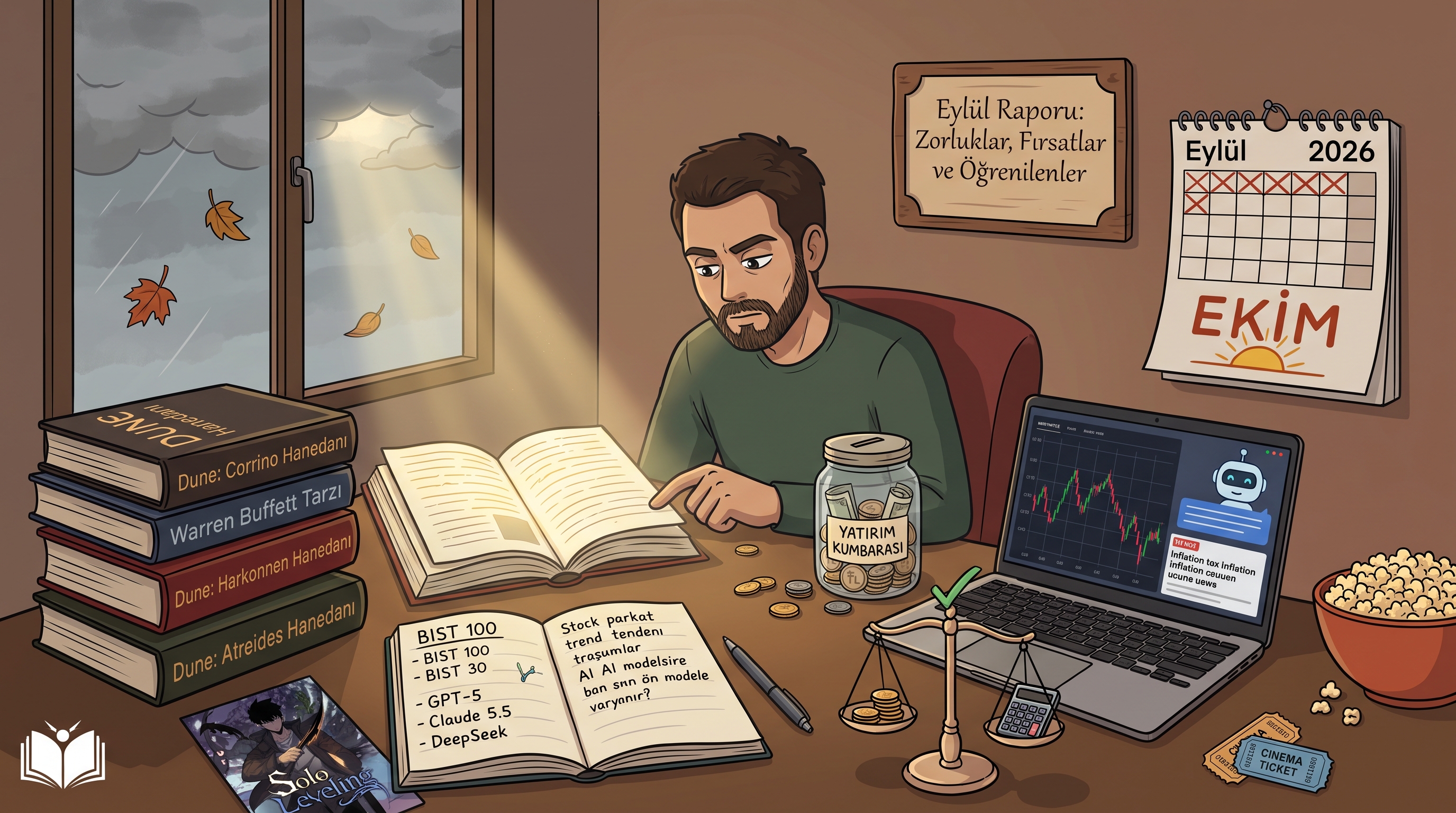
For last month I had planned to finish both series but couldn’t. I finished the Dynasty Series; since both series’ books are thick, the Legends Series remains. Alongside it I read a finance book, “The Warren Buffett Way.” It became the best finance book I’ve read. The reason it’s the best is actually all my earlier reading supporting it. Before this book, I didn’t know I was applying the Warren Buffett approach one-to-one. After so many videos, courses, and books, I had thought I found on my own that this approach was the right one; turns out it was found years ago. :)
On books I couldn’t finish all three, but I threw myself into projects; saying I worked day and night for the last two weeks especially would be accurate. On films, I watched and played games in my free time; I think I watched enough to clear my head. I don’t want burnout when this drops. A person must manage their own psychology; most of the work ends there. When you manage your psychology, you can do most of what you set out to do.
Books Finished in September
- Dune: House Corrino (Dune: Corrino Hanedanı, Dynasty Series #3) — Brian Herbert
- The Warren Buffett Way (Warren Buffett Tarzı) — Robert G. Hagstrom
- Dune: House Harkonnen (Dune: Harkonnen Hanedanı, Dynasty Series #2) — Brian Herbert
- Dune: House Atreides (Dune: Atreides Hanedanı, Dynasty Series #1) — Brian Herbert
September 2026 Watch List
Movie List (30)
- The Life of David Gale — Ölümle Yaşam Arasında (2003) | My rating: 8/10 | IMDb: 7.5/10 | https://www.imdb.com/title/tt0289992/
- Meet Joe Black — Joe Black (1998) | My rating: 8/10 | IMDb: 7.2/10 | https://www.imdb.com/title/tt0119643/
- Heart of the Beast — Vahşinin Kalbi (2026) | My rating: 8/10 | IMDb: 7.3/10 | https://www.imdb.com/title/tt7526136/
- Hope — Umut (2026) | My rating: 7/10 | IMDb: 6.9/10 | https://www.imdb.com/title/tt27369017/
- The End of Oak Street — Oak Caddesi’nin Sonu (2026) | My rating: 7/10 | IMDb: 6.4/10 | https://www.imdb.com/title/tt27165187/
- The Fix — Çözüm (2026) | My rating: 3/10 | IMDb: 4.8/10 | https://www.imdb.com/title/tt9601292/
- Elevation — Yükseklik (2024) | My rating: 5/10 | IMDb: 5.7/10 | https://www.imdb.com/title/tt23558280/
- One Night Only — Sadece Bir Gece (2026) | My rating: 6/10 | IMDb: 6.1/10 | https://www.imdb.com/title/tt37853455/
- Spider-Man: Brand New Day — Örümcek-Adam: Yepyeni Bir Gün (2026) | My rating: 8/10 | IMDb: 8/10 | https://www.imdb.com/title/tt22084616/
- The Skin I Live In — İçinde Yaşadığım Deri (2011) | My rating: 7/10 | IMDb: 7.6/10 | https://www.imdb.com/title/tt1189073/
- End of Watch — Tehlikeli Takip (2012) | My rating: 6/10 | IMDb: 7.6/10 | https://www.imdb.com/title/tt1855199/
- The Dog Stars — Köpek ve Yıldızlar (2026) | My rating: 8/10 | IMDb: 6.5/10 | https://www.imdb.com/title/tt21285562/
- Phone Booth — Telefon Kulübesi (2002) | My rating: 6/10 | IMDb: 7.1/10 | https://www.imdb.com/title/tt0183649/
- The Gentlemen — Beyefendiler (2019) | My rating: 8/10 | IMDb: 7.8/10 | https://www.imdb.com/title/tt8367814/
- Everest — Everest (2015) | My rating: 7/10 | IMDb: 7.1/10 | https://www.imdb.com/title/tt2719848/
- Deja Vu — Deja Vu (2006) | My rating: 8/10 | IMDb: 7.1/10 | https://www.imdb.com/title/tt0453467/
- 1917 — 1917 (2019) | My rating: 8/10 | IMDb: 8.2/10 | https://www.imdb.com/title/tt8579674/
- Mayday — Mayday (2026) | My rating: 7/10 | IMDb: 6.9/10 | https://www.imdb.com/title/tt28014327/
- The Oxford Murders — Oxford Cinayetleri (2008) | My rating: 7/10 | IMDb: 6/10 | https://www.imdb.com/title/tt0488604/
- McVeigh — Mcveigh: Gölgedeki Adam (2024) | My rating: 3/10 | IMDb: 4.4/10 | https://www.imdb.com/title/tt32141536/
- The Weight — Ağırlık (2026) | My rating: 6/10 | IMDb: 7/10 | https://www.imdb.com/title/tt10794054/
- The Runner — Koşucu (2026) | My rating: 4/10 | IMDb: 4.2/10 | https://www.imdb.com/title/tt34564059/
- Boss — Patron (2025) | My rating: 6/10 | IMDb: 5.7/10 | https://www.imdb.com/title/tt31645750/
- The Mongoose — The Mongoose (2026) | My rating: 2/10 | IMDb: — | https://www.imdb.com/title/tt13611778/
- Hitman — Hitman (2007) | My rating: 7/10 | IMDb: 6.2/10 | https://www.imdb.com/title/tt0465494/
- Hitman: Agent 47 — Hitman: Ajan 47 (2015) | My rating: 6/10 | IMDb: 5.7/10 | https://www.imdb.com/title/tt2679042/
- Just Play Dead — Ölü Taklidi Yap (2026) | My rating: 2/10 | IMDb: 5.3/10 | https://www.imdb.com/title/tt36948232/
- Dracula: A Love Tale — Drakula: Bir Aşk Hikayesi (2025) | My rating: 2/10 | IMDb: 6.2/10 | https://www.imdb.com/title/tt31434030/
- Long Gone Heroes — İntikam Operasyonu (2024) | My rating: 3/10 | IMDb: 5.1/10 | https://www.imdb.com/title/tt6001846/
- Mutiny — İsyan (2026) | My rating: 5/10 | IMDb: 5.7/10 | https://www.imdb.com/title/tt32338669/
TV Series List (7)
- The Boys (Çocuklar) — Season 5 (2026) | My rating: 8/10 | IMDb: 7.3/10 | https://www.imdb.com/title/tt1190634/
- The Mentalist — Season 2, Zihin Okuyucu (2009) | My rating: 6/10 | IMDb: 7.9/10 | https://www.imdb.com/title/tt1196946/
- Reacher — Season 4 (2026) | My rating: 7/10 | IMDb: 7.9/10 | https://www.imdb.com/title/tt9288030/
- The Mentalist — Season 1, Zihin Okuyucu (2008) | My rating: 6/10 | IMDb: 7.8/10 | https://www.imdb.com/title/tt1196946/
- Hostage — Rehin (2025) | My rating: 3/10 | IMDb: 6.5/10 | https://www.imdb.com/title/tt31407004/
- Silo — Season 3 (2026) | My rating: 8/10 | IMDb: 7.8/10 | https://www.imdb.com/title/tt14688458/
- Lucky — Season 1, Şanslı (2026) | My rating: 6/10 | IMDb: 6.7/10 | https://www.imdb.com/title/tt34866681/
I have a habit of watching a whole season in one sitting once it’s complete; it’s been this way for years. Waiting for new episodes on a busy schedule isn’t for me. Before I can ask “when is it coming out,” the season finale has already aired; I list it and watch everything back to back once complete. I think Netflix has given us this habit lately — before, everyone used to wait impatiently for shows every week; now nobody waits, they watch other things saying they’ll catch the evening shows in full on YouTube the next day. Media is incredibly powerful; it holds the ability to shape every society in the world.
Anime List (2)
- Ore dake reberu appu na ken — Season 2, Solo Leveling (2025) | My rating: 10/10 | IMDb: 9/10 | https://www.imdb.com/title/tt21209876/
- Ore dake reberu appu na ken — Season 1, Solo Leveling (2024) | My rating: 10/10 | IMDb: 8.5/10 | https://www.imdb.com/title/tt21209876/
Manhwa List (1)
- Solo Leveling (2018) | My rating: 10/10
No matter how many times I’ve read and watched it before, Solo Leveling is one of the weapons I use as a great distraction whenever I’m overwhelmed — most people call it cliché, but watching a person’s rise from rock bottom in a fun, compact way lifts my motivation.
Investments and the Break
About a month ago a friend of mine directed a substantial amount of money into various investments on his banker’s advice and asked what I thought. Sadly, as always, such opinions get asked after the investment is made. The portfolio was concentrated in two items: an index fund and one of the funds currently under investigation. The rest was spread across gold and US stocks.
Even if the funds’ returns look nice, I told him the figure could be virtual and that we were in a period when a full exit was still possible, and I asked him: “Can you exit whenever you want?” He had no answer. I didn’t break my rule of giving orders to anyone here either. I didn’t say “exit”; I only explained the risk.
We went through the fund’s holdings one by one. I showed him that most of the top-ranked stocks shouldn’t really be listed at all. I followed the same method with the index fund. I can understand the companies in the BIST 30, but I took up the roughly 40 companies in the BIST 100 one by one and explained that they entered the index because of the rules and shouldn’t actually be there. Two weeks later, events broke out.
On my own side, I hadn’t invested in the market for months; I expected an outburst and a fall. I expected a rebound around the 12,400–12,600 levels, not today’s 12,000s. What I failed to calculate, I confess: it never occurred to me that people would pull out of the other, poorly managed funds out of fear too. We often speak assuming people know a lot; I forget that they invest without even knowing a fund’s structure. Had I accounted for that, I’d have guaranteed a fall below 12,000. Fund managers would sell knowing redemptions were coming; people’s exits amplified the effect. It may continue, but as of the day I’m writing, we may have seen the bottom — unless there’s one more leg down.
Frankly, I ended up spending the money I’d kept waiting for stock purchases on my purchases this week; those were purchases I’d awaited for months. There were companies I’d been studying for a while, and since I thought the market was very cheap, these levels looked very reasonable to me. Still, let me add: in our country you never know what will happen, so I take care never to buy with all my money — always keeping some aside creates a safety margin.
For October I want to finish the Dune: Legends Series and bid the universe farewell until the film — in a way, reading it over such a long time closed its gap with the film (a poor man’s consolation :)). These dips always whet my appetite for learning about finance, so I want to read more on that side — with the cold here, I hope to spend a peaceful month with a hot coffee and a knowledge-packed book.
Wishing you well as we say goodbye to another month.