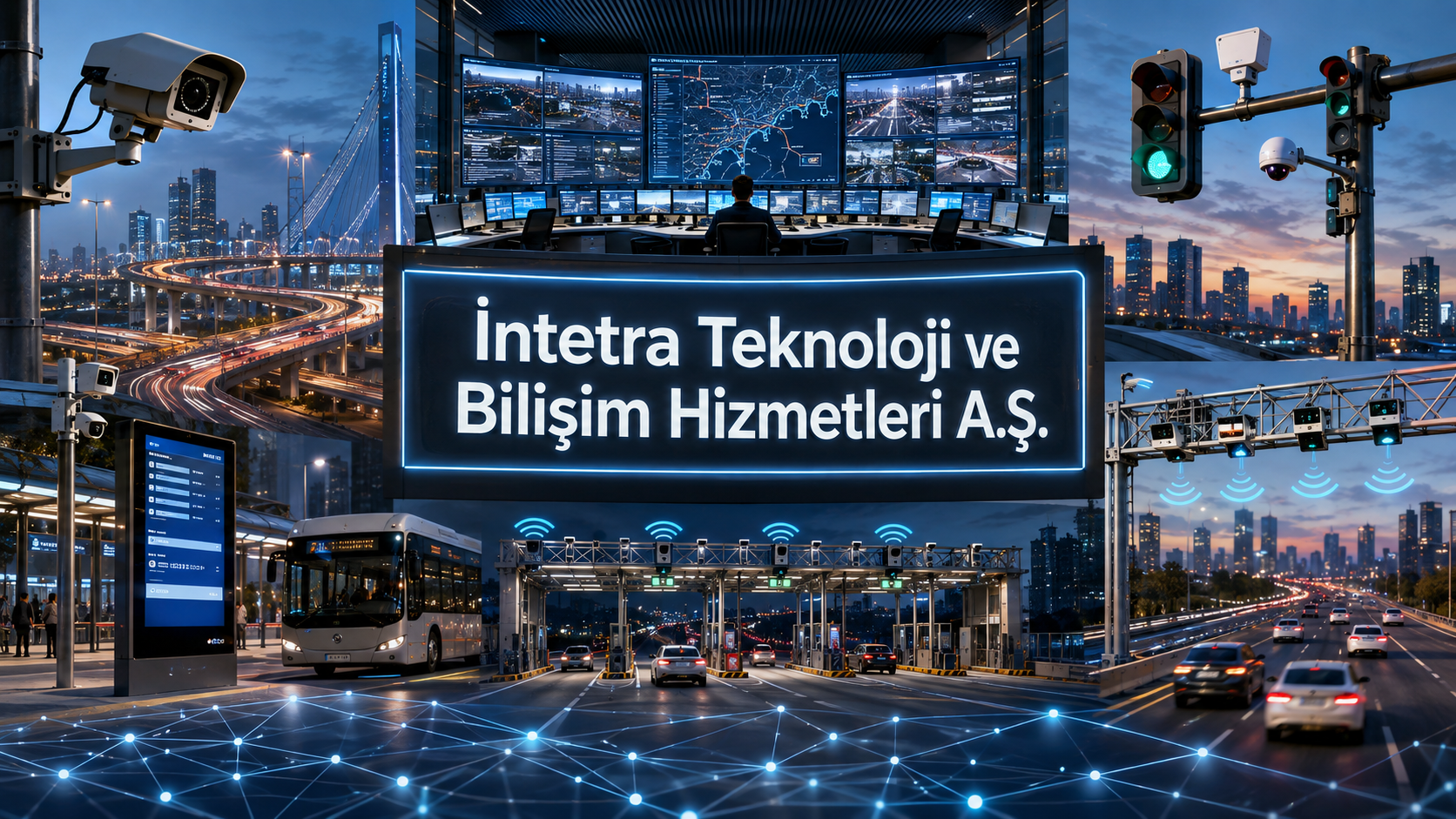
I don’t know whether it is simply a coincidence or whether there is a particular reason why the Capital Markets Board (CMB) tends to approve companies with similar market capitalizations in the same week. Why we sometimes see three or four IPOs in one week and none the next is another mystery. I’m sure they have their reasons. Anyway, back to the company. As the Turkish stock market continues to diversify, we are once again looking at a company operating in a relatively distinct field. Intetra operates across three main business segments: Intelligent Transportation Systems (ITS), Toll Collection Systems (TCS), and Railway and Rail Systems.
The Company’s Business Segments and Operating Model
Quite frankly, while I was familiar with these business segments by name, I think looking at them in more detail will help us better understand the company:
- Intelligent Transportation Systems (ITS): Advanced technological solutions designed to improve traffic flow on highways and urban roads, enhance road safety, and monitor traffic in real time. This segment covers the software, design, and installation of roadside sensors, traffic monitoring cameras, weather stations, LED variable message signs (VMS) that provide information to drivers, and electronic enforcement systems (EDS) used to detect speeding and red-light violations.
- Toll Collection Systems (TCS): Infrastructure that enables fast and automated toll collection on highways, tunnels, bridges, and parking facilities. This includes vehicle identification technologies such as HGS/RFID tags, multi-lane free-flow (MLFF) systems that allow vehicles to pass without stopping, barrier-based toll booth systems, and transaction software integrated with banking systems.
- Railway and Rail Systems: Electromechanical infrastructure and signaling solutions designed for the safe operation of metro, tram, and railway lines. This segment includes railway signal lights compliant with international safety standards such as SIL3, automatic incident detection sensors that monitor train movements, electromechanical tunnel control systems, and real-time passenger information systems (PIS) used at stations.
The company’s business model is built around the integrated management of data generation, data processing, and operational processes across mobility infrastructure. Field systems and hardware platforms generate traffic and operational data, software systems process that data, and control systems turn it into decisions and operational actions. The data itself belongs to the relevant public institutions and is processed by the company as part of the services it provides. Therefore, it would not be accurate to view Intetra simply as a traditional hardware company selling field equipment; software, data processing, and operational management also represent an important part of its business model.
Revenue Model and Segment Breakdown
The company’s revenue model has a multi-layered structure that combines project-based income with recurring revenue streams:
- Hardware revenue: Project-based income generated from the sale of field devices and infrastructure components.
- Software licensing revenue: Income generated from granting usage rights for platforms and software components.
- Transaction-based revenue: Income tied to providing transaction infrastructure for electronic toll collection and similar systems.
- Maintenance and operations revenue: Recurring income generated from system operation, maintenance, and support services.
Looking at the revenue breakdown by business segment, we can see a clear shift in the company’s revenue mix over time. ITS has lost a significant portion of its historical weight, while TCS has become the company’s strongest segment, particularly in 2025 and the first quarter of 2026. Railway and Rail Systems, meanwhile, has shown substantial growth. The segment generated no revenue in 2023, but reached TRY 115.3 million in 2024 and TRY 346.3 million in 2025. In the first quarter of 2026, it generated TRY 145.8 million in revenue and accounted for roughly 23.2% of total sales, surpassing ITS at approximately 18.3%.
Intelligent Transportation Systems (ITS)
2023: 1,719,686,597 TRY • 2024: 756,926,812 TRY • 2025: 930,386,841 TRY • Q1 2026: 114,930,124 TRY
Toll Collection Systems (TCS)
2023: 965,156,720 TRY • 2024: 837,840,357 TRY • 2025: 1,293,164,315 TRY • Q1 2026: 368,277,968 TRY
Railway and Rail Systems
2023: None • 2024: 115,266,019 TRY • 2025: 346,307,321 TRY • Q1 2026: 145,808,937 TRY
What stands out to me most is how the company’s revenue mix has been changing over time. As the historical dominance of ITS declines, the strengthening of TCS and the rapid growth of Railway and Rail Systems are reducing the company’s dependence on a single business segment. The slowdown in major highway and railway infrastructure investments in Türkiye after the pandemic may have contributed to volatility in some project-based operations. On the other hand, the company’s efforts to expand into new business areas and pursue export-oriented innovations, while consistently generating export revenue each year, can be viewed positively.
IPO Structure and Use of Proceeds
The fact that the company has a single shareholder and that roughly 25% of the IPO consists of a secondary share sale immediately stands out. However, I view it positively that the proceeds from the secondary sale have been allocated to price stabilization in the event of potential declines in the share price. Excluding the secondary-sale portion, the net proceeds flowing into the company will be approximately TRY 1.530 billion. The company’s IPO market capitalization has been set at TRY 8.576 billion, and these are the figures on which we will primarily base our analysis.
The company’s free float has been set at 25%. However, if the shares allocated for price stabilization are used, roughly 5% may effectively be repurchased by the selling shareholder, which would place the effective free float in the 20-25% range. In my view, this is a reasonable level.
The planned use of proceeds is as follows:
- 35% – Working Capital Enhancement: The funds will be used to increase the number of qualified employees across production, sales, marketing, and R&D, as well as to finance raw material and energy purchases.
- 65% – Investment Financing: Of this amount, 63% will be allocated to Intetra Teknoloji for the modernization of its production facility, new assembly lines, R&D and testing centers, and machinery purchases; 30% will be allocated to the geothermal greenhouse investment in Konya through its subsidiary Birleşik Seracılık; and 7% will be allocated to investments by its subsidiary Tetra HGS.
The funds transferred to subsidiaries will not be provided as outright grants or capital injections. Instead, they will be structured as shareholder loans bearing market-based interest and are intended to be repaid. I consider this an important detail because, rather than transferring the IPO proceeds to subsidiaries without recourse, the company is establishing a recoverable financing relationship on its balance sheet.
Geothermal Greenhouse Investment and Non-Core Ventures
We will be able to judge more clearly whether the amount allocated to working capital is truly necessary once we examine the financial statements. On the investment side, however, the geothermal greenhouse project in Konya particularly catches my attention. Since I do not know every detail of the company’s core operating structure, I do not want to draw overly definitive conclusions. Still, the fact that a technology company is allocating a significant amount of capital to a subsidiary operating in a sector far removed from its core business raises strategic questions for me. It gives me the impression that the owners have an appetite for experimental investments in unrelated industries. Whether this turns out to be positive or negative remains to be seen.
On the other hand, I view the detailed and transparent disclosure of the use of proceeds positively. Looking at the company’s ongoing investments, we can see that the modern geothermal-heated greenhouse project in Akşehir, Konya, under Birleşik Seracılık is continuing and that the company clearly attaches significant importance to this business. The investment is being carried out in two phases: the first phase is expected to be completed by year-end, while the second phase will be financed with IPO proceeds. Therefore, what may initially appear to be an unrelated side investment seems to be part of a longer-term strategy rather than a temporary or small-scale experiment.
Financial Position and Balance Sheet Analysis
Turning to the financial statements, cash and cash equivalents have increased over the years and reached TRY 416 million. Trade receivables stand at TRY 553 million, while trade payables are TRY 229 million. The collection period for receivables has declined from around 110 days to 70 days over time, while the payment period for payables has similarly fallen from 107 days to 44 days. If the receivables-payables balance were negative, I would consider this structure quite unfavorable for the company. However, with trade receivables standing at more than twice the level of trade payables, some of the concerns related to turnover periods can be overlooked to a certain extent.
Inventories have remained relatively stable over the years and currently stand at TRY 556 million. Another important line item under current assets is Contract Assets, which amounts to a sizeable TRY 491 million. Looking into the details, these receivables are generally realized within average maturities of 30 to 120 days and have grown over time. Based on the current figures, and assuming collections proceed as planned, I believe the company has the potential to generate around TRY 2 billion in cash inflows over the next twelve months, excluding IPO proceeds. Including the funds raised through the IPO, its total liquidity capacity could approach TRY 3.5 billion. This figure will be particularly important when assessing the company’s leverage.
Debt Structure and Cash Flow
The company has TRY 317 million in short-term financial debt and TRY 229 million in trade payables. Since the combined amount is roughly equivalent to trade receivables, I do not see any significant short-term debt risk at this stage. The TRY 196 million recorded under Contract Liabilities also appears comfortably covered by the corresponding asset side. Long-term debt stands at TRY 264 million, and considering the company’s current cash position and cash generation capacity, this level does not look risky to me.
Looking at borrowing trends over the years, the company appears to have maintained broadly similar debt levels without moving into excessively risky leverage at any point. As a result, I do not see any major red flags on the debt side of the balance sheet. When cash, trade receivables, and contract assets are considered together, the company appears to have a strong capacity to meet both its short- and long-term obligations.
Income Statement and Margin Analysis
The first thing that catches my attention in the income statement is that, despite rising inflation over the years, the company’s costs have not increased at the same pace. This suggests that the cost base has been managed relatively well.
Net Revenue
2023: 2,663.6 million TRY • 2024: 1,707.9 million TRY • 2025: 2,567.2 million TRY • Q1 2025: 307.7 million TRY • Q1 2026: 629.0 million TRY
Gross Profit Margin
2023: 41% • 2024: 38% • 2025: 31% • Q1 2025: 2% • Q1 2026: 29%
Operating Profit Margin
2023: 23% • 2024: 23% • 2025: 18% • Q1 2025: -17% • Q1 2026: 19%
Net Profit Margin
2023: 23% • 2024: 8% • 2025: 7% • Q1 2025: -27% • Q1 2026: 3%
Adjusted Net Profit Margin
2023: 23.9% • 2024: 12.9% • 2025: 13.2% • Q1 2025: -6.4% • Q1 2026: 10.6%
Because Intetra operates on a project-based business model, changes in project numbers and project sizes can have a significant impact on revenue from one period to another. This is clearly reflected in revenue declining from TRY 2,663.6 million in 2023 to TRY 1,707.9 million in 2024 before recovering to TRY 2,567.2 million in 2025. Meanwhile, the increase from TRY 307.7 million in Q1 2025 to TRY 629.0 million in Q1 2026 points to a strong recent recovery.
We can see a similar improvement in margins. Gross profit margin rose from just 2% in Q1 2025 to 29% in Q1 2026, while operating profit margin recovered from -17% to 19% and net profit margin improved from -27% to 3%. As I mention in many of my reviews, looking at the adjusted net profit margin is also useful for understanding profitability after isolating the impact of the net monetary position. On this basis, the margin improved from -6.4% in Q1 2025 to 10.6% in Q1 2026. In my view, these figures suggest that the bottoming-out signals we have seen in many other companies may also be beginning to appear here.
Final Assessment and Conclusion
Overall, I would describe the company’s business profile as half defensive and half risky. Recurring revenue provides an important advantage, but a significant portion of the company’s overall business volume remains project-based, leaving it exposed to external factors. For that reason, I do not think the company can be classified as having a completely low-risk business model. At the same time, the shift in revenue composition over recent years is noteworthy. As the historical weight of ITS declines, TCS is strengthening and Railway and Rail Systems is growing rapidly, which suggests that the company’s operations are gradually becoming more balanced.
In the current environment of tight monetary policy, which I believe could continue for roughly another year, I see difficulty in securing new projects as one of the company’s main risks. Weaker new-project volume would naturally limit revenue growth. If I were investing in the company, I would continue to follow company announcements, upcoming tenders, and especially major new contracts closely. Significant new contract wins could materially alter both the revenue outlook and the valuation.
On the financial side, however, the picture looks much more positive to me. The company’s debt structure appears quite solid, supported by its history of avoiding excessive leverage and its current cash generation capacity. Even under adverse external conditions, I do not expect the company to face serious difficulty meeting its debt obligations. This is precisely why allocating 35% of the IPO proceeds to working capital raises some questions for me. Given the existing balance sheet structure, that allocation feels high, and over time I would prefer to see a larger portion of those funds directed toward investments.
Taking the company’s cost structure, leverage, and cash flow together, I believe positive cash generation is likely to continue, as it has in previous years. In my view, the main uncertainty facing the company is not the balance sheet but its ability to win new projects. For that reason, rather than valuing the company on a single blended revenue figure, I believe it makes more sense to assess recurring and more predictable revenue separately from project-based revenue.
Under a more optimistic scenario in which project volumes return to historical levels, new contracts are secured, and the company successfully develops its current growth areas, I consider the company fairly valued at the IPO price. On the other hand, if current economic conditions persist, public and private sector investment remains cautious, and new project wins stay limited, I believe the company is approximately 40-45% overvalued.
LEGAL DISCLAIMER: This content does not constitute investment advisory services. Investment advisory is a personalized service provided based on an individual’s risk-return profile, financial standing, and investment objectives. The information, commentary, and assessments provided herein are prepared solely for general informational purposes and should not be construed as investment recommendations or guidance. This content may not align with the reader’s financial position or risk-return preferences; therefore, investing based solely on this information may not yield the expected outcomes.