As of August 28, 2026—the day I am writing this—I learned that the balance of the FX-Protected Deposit (KKM) scheme has been completely zeroed out, bringing the policy to an end. The report went on to state that the practice cost the state an estimated $60 billion. Reading the news, a wave of thoughts crossed my mind, and I felt compelled to write a piece to raise awareness about it. I thought it might help us better grasp some of the harsh realities of capitalism and the economic system we live in.
As you read this, I hope you don’t view it merely as a critique of Turkey’s monetary policy management. What I really want to convey is how the system works and the distinction between those who have a seat at the table and those left outside. I’d like to start by questioning what purpose an economic or political policy actually serves in any given country. In my view, this is where the core of the issue lies in all electoral political systems. Nowadays, political parties are forced to operate much like corporations. Just as corporations try to maximize their profits, political parties naturally try to maximize their votes.
Consequently, one of the fundamental questions driving political institutions is always: “How do we win the election?” Or put another way: “How do we get more votes?”
Because of this, vote maximization often plays a central role in shaping policies from the start. Of course, every enacted law and implemented policy is presented to the public as a measure to enhance social welfare. But from my perspective, the top priority for political actors is to gain or retain power; their second priority is to maximize societal welfare within those bounds. And that is precisely where the problem arises. When maximum benefit for society begins to conflict with vote maximization for the ruling party, chipping away at the public’s best interests can become almost inevitable.
I want to emphasize this point: what I’m describing isn’t unique to today’s Turkey or any single political party. To me, these are inherent features of the mechanism generated by electoral systems and human behavior. They have existed since the system was first established and will likely continue to exist in different forms. As humans, we dream of a better order. We design fairer, more rational, and flawless systems. We talk, debate, plan, and occasionally build utopias. Yet the inner mechanics of the system and human nature rarely allow those ideal worlds to materialize.
So What Does Any of This Have to Do with KKM?
Now, let’s get to the FX-Protected Deposit scheme. Without getting bogged down in technical details, the monetary policy approach of “interest rates cause inflation” came to the forefront in 2021. Under this rationale, it was believed that lowering interest rates would eventually help bring inflation down as well. I won’t debate whether that theory is right or wrong here—that’s not the subject of this post.
Driven by this approach, interest rates were cut. In an economy where inflation sits higher than interest rates, this creates negative real interest rates. As rates dropped further and real rates slid deeper into negative territory, savers became increasingly inclined to shift away from Turkish lira assets and move toward foreign currency assets. As a result, demand for foreign currency surged, causing the Turkish lira to depreciate rapidly.
To curb the rise in foreign exchange rates on one hand without backing away from its low-interest policy on the other, the economic administration at the time launched an unconventional financial tool rarely seen around the world: The FX-Protected Deposit scheme (KKM).
What Did KKM Offer to Savers?
Looking at the primary advantages KKM offered to savers, it isn’t hard to see why the system gained such traction:
- Protection against exchange rate risk: The main feature of KKM was that it shielded savers against the depreciation of the Turkish lira. If the rise in exchange rates exceeded the interest yield at maturity, the difference was paid out to the investor.
- Interest income plus upside potential: Savers earned deposit interest while remaining eligible for additional exchange rate differential payouts whenever currency depreciation outpaced the interest yield.
- Tax incentives: Various tax benefits were offered for KKM accounts at different stages of the implementation. For corporate entities, tax regulations were enacted to encourage converting foreign currency holdings into KKM.
- Reduced need to hold foreign currency directly: Savers could protect themselves against exchange rate volatility while staying in Turkish lira deposits rather than holding physical foreign currency positions.
- Mitigation of uncertainty: A state guarantee against potential losses during sharp exchange rate spikes eliminated one of the major uncertainties facing savers.
And that brings us to the very reason I decided to write this post.
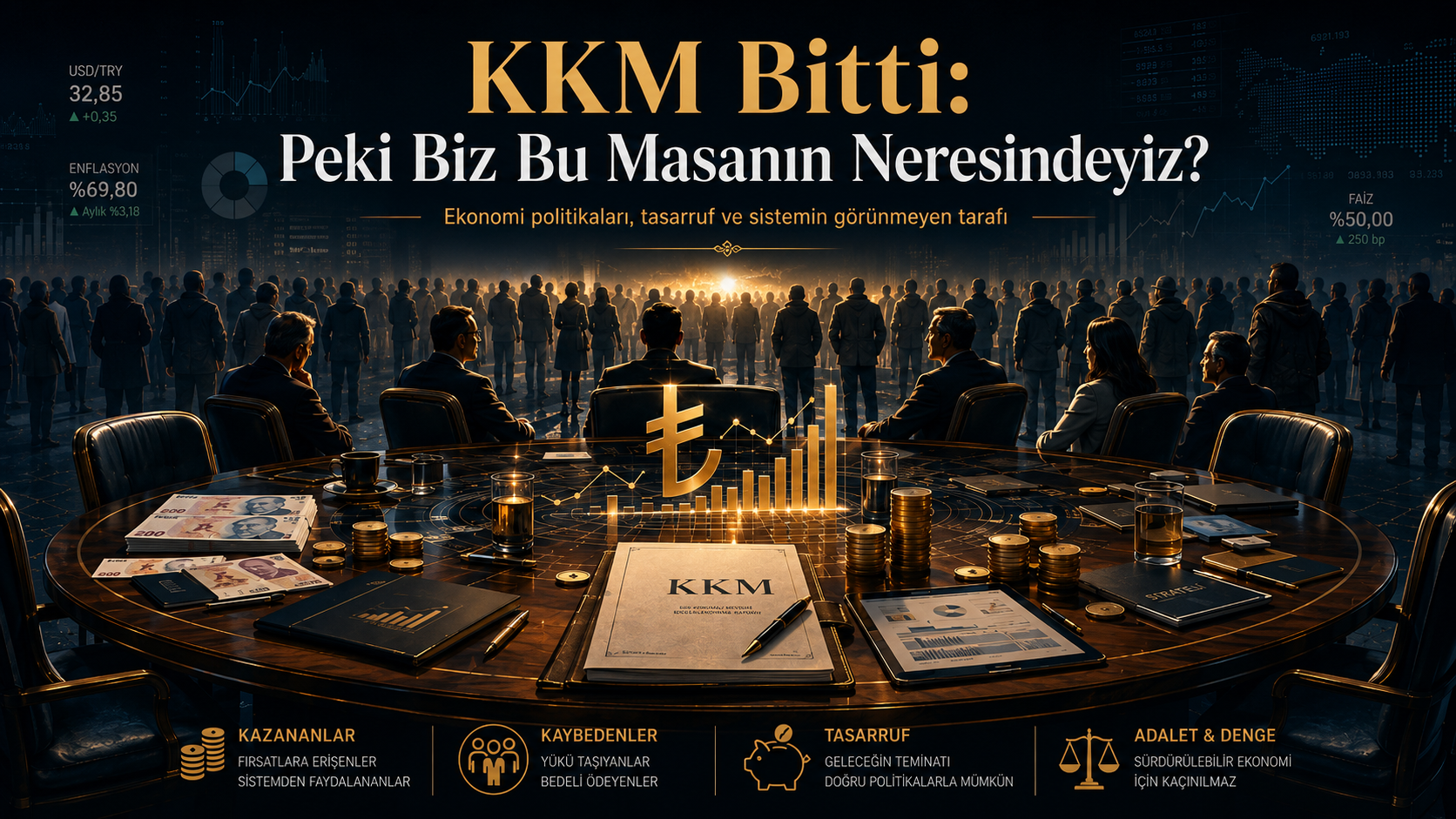
Are We at the Table, or Standing Outside?
So far, we’ve discussed the motivations that can drive policy creation within political systems, and we’ve seen the economic conditions and goals that led to KKM’s rollout. But why lay all of this out? My intention isn’t simply to criticize a specific government or bash the capitalist system. Nor am I trying to play the self-righteous preacher.
What I want to convey is much simpler: Are we in a position to take a seat at the table in this system, or are we left dealing with the fallout from the outside?
In my metaphor, those sitting at the table are savers who interpret economic and political shifts to grow their wealth. Those outside the table are the broader segments of society—working, producing, bearing the main weight of the system, but not yet possessing meaningful savings.
The main takeaway I hope you draw from all this is simple: This table will be set again and again.
What’s more, it’s not just ordinary individuals who have to navigate this system—the people running nations and institutions with massive economic power must do so as well. Leaders may change, governments may change, laws and economic policies may change, but the way the system creates incentives, winners, and losers remains largely the same.
Constantly dwelling on why the table was set a certain way can drain us mentally. The question that truly matters is: where do we stand when the table is set?
Who Carried the $60 Billion Burden?
Now, let me loop back to where we started. Assuming KKM cost the state roughly $60 billion, the question we must ask is: Who bore this burden, and who benefited from the policy?
I prefer to look at this system through three key actors.
1. The political structure executing the policy As I mentioned earlier, one of the primary goals of political institutions is vote maximization. The question here, then, is whether the policy delivered the intended political outcome.
I believe it did. In the elections following the implementation of these economic policies, the ruling party won and remained in power. From this angle, the first actor doesn’t appear to have failed in reaching its objective.
2. Savers The second group consists of savers who deposited funds into KKM. Re-examining the advantages KKM offered, the gain for this group is clear. On one hand, savers earned deposit interest; on the other, they held a government guarantee against the devaluation of the Turkish lira. Whenever exchange rate gains outpaced interest yields, the public balance sheet picked up the tab.
In other words, a major financial risk faced by individual savers was transferred onto the public sector. From this standpoint, the second group also derived substantial benefits from the system. Put simply, when the table was set, those with the capital to take a seat were able to capitalize on the opportunity.
3. The general public The third actor is society at large. The stated goal of presenting policies to the public is ultimately to preserve or improve societal economic well-being. Looking at the results, however, the picture isn’t particularly bright.
When KKM was introduced, the USD/TRY exchange rate was hovering around 18 TL, whereas today it stands near 48 TL. Prior to KKM, annual inflation was around 19.5% in September 2021; as of July 2026, annual inflation sits at roughly 31.75%. It would hardly be wrong to say that things didn’t turn out as well as hoped for the third actor.
So What Can We Actually Change?
Now we come to what I consider the most important part of this post. What I’m about to say might not sit comfortably with people who, like me, belong to this third group—the vast majority of society. But we have to ask ourselves: What can we actually change?
The conclusion I’ve reached is this: We may not always get to decide how the table is set.
No matter who we elect, which party we bring to power, or what laws we pass, as long as the core incentive structures of the system remain largely unchanged, similar tables will continue to be set. The players will change, policies will change, winners and losers will swap places, but the table will be set again.
That’s why the solution I’ve arrived at isn’t expending all my energy wondering why the table was set this way, but striving to be ready to take a seat when the next table is prepared. In short: building savings. Conveying this very realization is the primary reason I wrote this piece.
Securing a Seat at the Table
Let’s consider a simplified example using KKM. If $60 billion flowed out of state coffers, that expenditure was ultimately covered by society’s collective resources. Costs generated through taxes, public revenues, or monetary expansion were distributed directly or indirectly across the entire population.
However, gains derived from KKM were not distributed equally across society. Those with the savings to participate in the scheme benefited directly. In a way, while broader society shared in footing the bill for the table, only those with sufficient capital to take a seat could directly enjoy the meal.
Consider a simplified illustration. Suppose a saver contributed 1 unit in taxes to the system, but gained 3 units of economic benefit through KKM. At the end of the day: They paid 1 unit. They received 3 units. They ended up net positive by +2 units.
Of course, real-world math is far more complex than that. The goal here isn’t to calculate KKM’s returns down to the penny, but to illustrate the logic of wealth transfer. While someone without savings shares in the system’s costs, someone with sufficient savings can seize the opportunities that same system presents.
This is precisely the distinction I mean by “being at the table”: We may all end up paying a slice of the bill, but to take a seat, you need something in your pocket first.
Conclusion: Being Ready for the Next Table
I’ve rambled on enough. At the end of it all, the takeaway for me is fairly simple: We save. We read. We strive to understand the economy. And we wait patiently, like a hunter waiting for game.
Because the economic system constantly sets new tables. Sometimes in interest rates, sometimes in foreign currencies, equities, real estate, economic crises, or financial instruments we’ve never seen before—like KKM. But the first prerequisite for sitting at any of these tables remains unchanged: Having savings ready to deploy when opportunity knocks.
We might not choose when the table is set, nor can we always write its rules. But making the financial and mental preparations to take a seat—rather than watching from the outside—is entirely in our hands.
That’s my takeaway from writing this. Because it’s never just about how the table is set; it’s whether we’re in a position to take a seat when it is. If you’ve read this far, chances are you already know what you need to do next…