For years, initial public offerings on Borsa Istanbul have predominantly involved industrial companies. We are far less accustomed to seeing financial institutions such as banks and insurance companies enter the stock market through public offerings.
While banking and financial companies once represented nearly 57% of Borsa Istanbul, this figure has reportedly declined to approximately 15% today. This transformation clearly demonstrates how significantly the financial sector’s weight in the stock market has changed over time.
Moreover, even when companies hold billions of Turkish lira in non-current assets, I believe that the factor that truly creates value under today’s economic conditions is their ability to generate cash flow. Vestel can be considered a good example of this dynamic.
Although analyzing industrial companies has become almost second nature to me, I cannot say that I have the same level of familiarity with the banking and insurance sectors. To gain a better understanding of the insurance industry, I have done a considerable amount of reading this year and learned several new concepts through the lens of this IPO.
Nevertheless, the sector has its own unique dynamics, complex calculation methods, and financial metrics that I have not yet fully mastered.
For this reason, it is worth stating at the outset that those looking for an in-depth, professional-grade financial analysis should view this review primarily as a personal study note.
Rather than repeating standard IPO information, I will examine the company’s offering structure, balance sheet details, operational position, and debt-receivables balance from an investor’s perspective.
IPO Structure and Secondary Share Sale
The absence of any secondary share sale and the fact that the offering is being conducted entirely through a capital increase leave a highly positive impression.
Considering that capital in the insurance industry directly supports working capital and investments, the fact that 100% of the IPO proceeds will remain within the company represents a significant advantage.
The key structural features of the IPO are as follows:
- Capital Increase: The IPO will be conducted entirely through a capital increase, with no sale of shares by existing shareholders.
- Low Free Float: Only 10% of the company is planned to be offered to the public.
- Price Stabilization: Price stabilization transactions are expected to be carried out for 30 days using 20% of the gross IPO proceeds.
The decision of existing shareholders not to sell any shares, together with the relatively low 10% free-float ratio, signals strong insider confidence. It also suggests a focus on institutionalization and greater transparency.
As long as the company’s financial indicators remain positive, it would be fair to say that a fundamentally solid company, worthy of periodic portfolio monitoring, is joining the stock exchange.
Use of Proceeds and Cash Requirements
All of the approximately TRY 3.7 billion expected to be raised through the IPO will remain within the company.
Since the insurance business model relies heavily on liquidity, capital management, and the effective deployment of cash, this injection will make a significant contribution to the company’s existing liquidity pool.
Considering the overall size of the balance sheet, I view these proceeds as a substantial cash inflow that will further strengthen the company’s financial structure.
Operational Structure and Growth Potential
The revenue models of insurance companies and similar financial institutions can generally be examined under three main categories:
- Non-Life Insurance: Includes areas such as fire, natural disasters, accidents, motor, marine and aviation insurance, cargo transportation, engineering, and agriculture.
- Life Insurance: Includes death, disability, credit and financial protection, critical illness, and education-related coverage.
- Pensions: Primarily represents long-term savings and investment products rather than conventional risk underwriting.
Although the pension segment has gained momentum across the industry in recent years, its contribution to the company’s total revenue remains relatively limited.
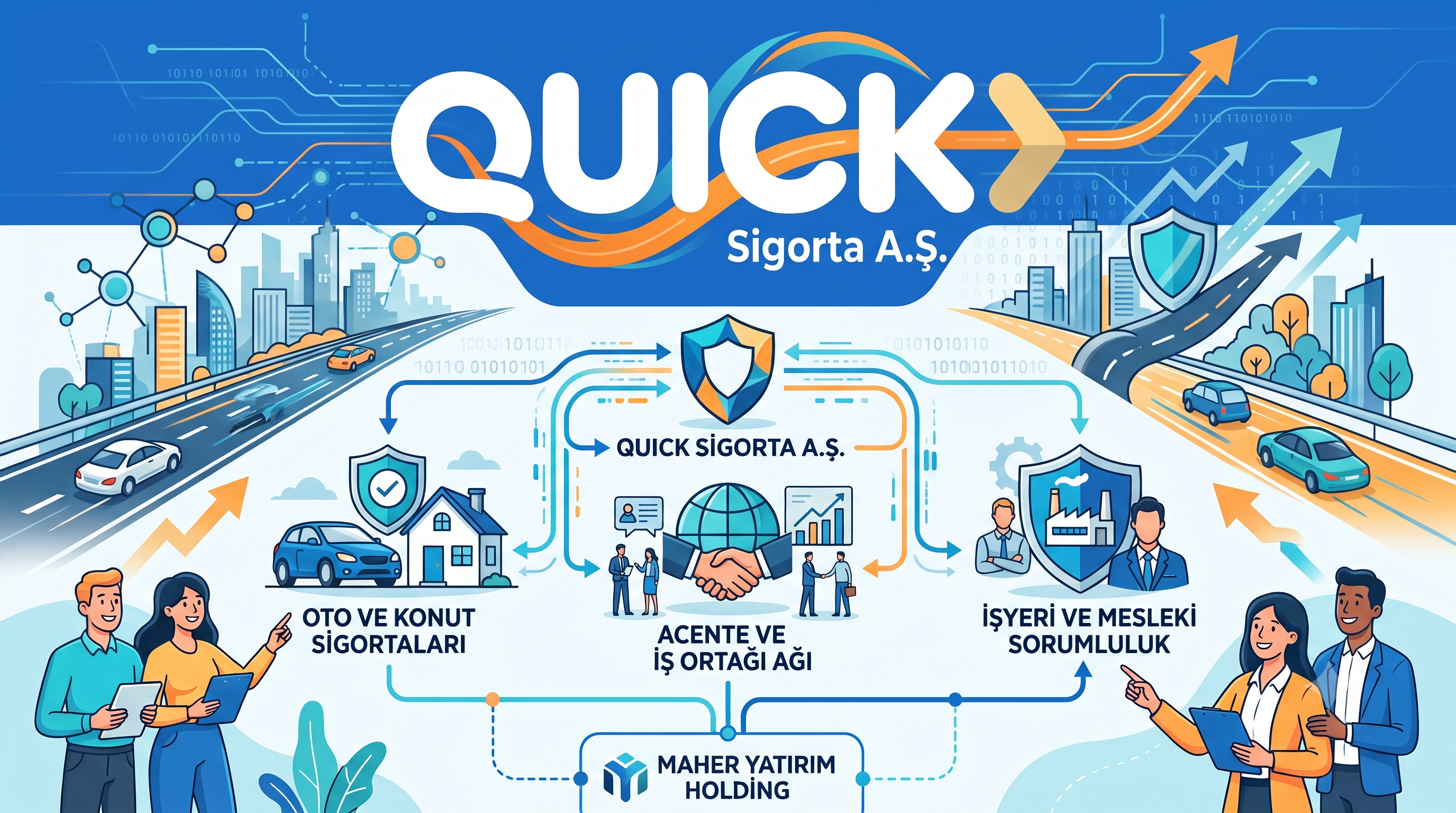
Looking at Quick Sigorta’s financial statements, almost all of its revenue is generated from the non-life insurance segment.
However, one critical industry-wide metric stands out: the combined ratio, which measures the profitability and operational efficiency of underwriting activities.
A combined ratio of approximately 101% indicates that the company is not generating a direct underwriting profit from its core insurance operations.
Although combined ratios above 100% are common among many industry participants, with only a limited number of exceptions, a 101% combined ratio is still an important factor to consider for a business model heavily concentrated in non-life insurance.
On the other hand, during periods of high interest rates, insurance companies can generate substantial investment income by allocating premium inflows to interest-bearing deposits, treasury bills, government bonds, Eurobonds, and similar financial instruments.
Therefore, even if underwriting profitability remains weak, net profit can still be strongly supported by investment income.
The main income statement items can be summarized as follows:
- Pensions: There is no operating income or expense.
- Life Insurance: This segment represents a limited share of total volume and recorded a modest loss of approximately TRY 150 million, which remains relatively small considering the scale of the company.
- Non-Life Insurance: The revenue-expense difference closed 2025 at TRY 10.247 billion. Profitability increased significantly above inflation compared with previous years.
- Investment Income and Financial Expenses: Investment income reached TRY 22.766 billion, while financial expenses amounted to TRY 20.552 billion.
Thanks to the positive contribution from investment income, the company closed 2025 with a net profit of TRY 10.713 billion.
Although the upward momentum appears to have slowed somewhat in the current period, the overall positive trend remains intact.
Debt Structure, Receivables, and Cash Cycle
The company’s total current assets amount to TRY 92.156 billion.
Its asset structure and receivables-payables balance can be summarized as follows:
- Cash Position: Cash and cash equivalents total TRY 54.628 billion.
- Financial Assets: Trading financial assets amount to TRY 21.148 billion.
- Insurance Receivables and Payables: Operating receivables stand at TRY 2.311 billion, while operating payables amount to TRY 1.231 billion. This leaves the company with a net receivable position of more than TRY 1 billion. Receivable maturities range between one and three months, while payable maturities extend up to three months, which supports the company’s cash flow profile.
- Other Miscellaneous Receivables: Of the TRY 11.210 billion recorded under this item, TRY 9.367 billion consists of consumer and commercial loans extended to customers by the subsidiary Quick Finansman A.Ş. Nearly all of the remaining amount relates to the inventories of MHR GYO, QC İnşaat, and QCar, which operate in real estate development and vehicle rental.
An examination of the liability side reveals an upward trend over time:
- Payables to Credit Institutions: TRY 4.418 billion
- Issued Bonds and Bills: TRY 2.685 billion
- Total Financial Debt: TRY 7.127 billion
- Technical Reserves: TRY 58.517 billion
Although technical reserves are recorded as liabilities due to the nature of the insurance business model, they represent a manageable 63.5% of current assets.
As long as claims are not paid during the policy period, these reserves can be invested in government bonds, treasury bills, Eurobonds, and other yield-generating financial instruments, thereby making an active contribution to net profitability.
As someone who is relatively new to insurance sector analysis, I believe an alternative approach may be considered when calculating the company’s actual return on equity.
Since technical reserves generate investment income throughout the policy period, I am inclined to include their contribution in the analysis rather than treating them solely as liabilities and excluding them entirely from the capital base, as is commonly done in standard assessments.
From the perspective of how I interpret financial statements, I find this approach quite logical.
Valuation and Future Outlook
The company is expected to go public at a market capitalization of TRY 33.190 billion.
Assuming that net profit grows broadly in line with inflation, I estimate that year-end net profit could fall within the range of TRY 13.5–14 billion.
Based on discounted cash flow expectations for 2027 as of August, the company appears to be valued at an implied price-to-earnings ratio of approximately 2.5–2.75 under a base-case scenario.
Since I do not expect the inflationary environment to begin decelerating meaningfully before mid-2027, I believe the company will continue to benefit from the favorable conditions created by high interest rates throughout 2027.
From this perspective, I consider the IPO valuation to be quite reasonable.
Overall Assessment
Taking a comprehensive view of the Quick Sigorta IPO, several key positive factors stand out:
The absence of secondary shareholder sales, the fact that all IPO proceeds will enter the company through a capital increase, the low 10% free-float ratio, and the company’s strong cash position all create a favorable overall picture.
In addition, returns generated from technical reserves and current assets in a high-interest-rate environment directly support the company’s net profitability.
On the other hand, the 101% combined ratio, which reflects the performance of the company’s core underwriting operations, and its heavy dependence on the non-life insurance segment are important risk areas that should be monitored closely.
Nevertheless, considering the maturity profile of its liabilities, the TRY 3.7 billion cash injection expected from the IPO, and the estimated price-to-earnings ratio of 2.5–2.75, the company presents a profile that deserves to remain on investors’ radar.
Key Points to Monitor
- A detailed examination of the financial structures of subsidiaries including Quick Finansman A.Ş., MHR GYO, QC İnşaat, and QCar.
- Whether the company can reduce its combined ratio below 100% in the coming periods.
LEGAL DISCLAIMER: This content does not constitute investment advisory services. Investment advisory is a personalized service provided based on an individual’s risk-return profile, financial standing, and investment objectives. The information, commentary, and assessments provided herein are prepared solely for general informational purposes and should not be construed as investment recommendations or guidance. This content may not align with the reader’s financial position or risk-return preferences; therefore, investing based solely on this information may not yield the expected outcomes.