## My Impressions of the Kervan Gıda Annual General Meeting
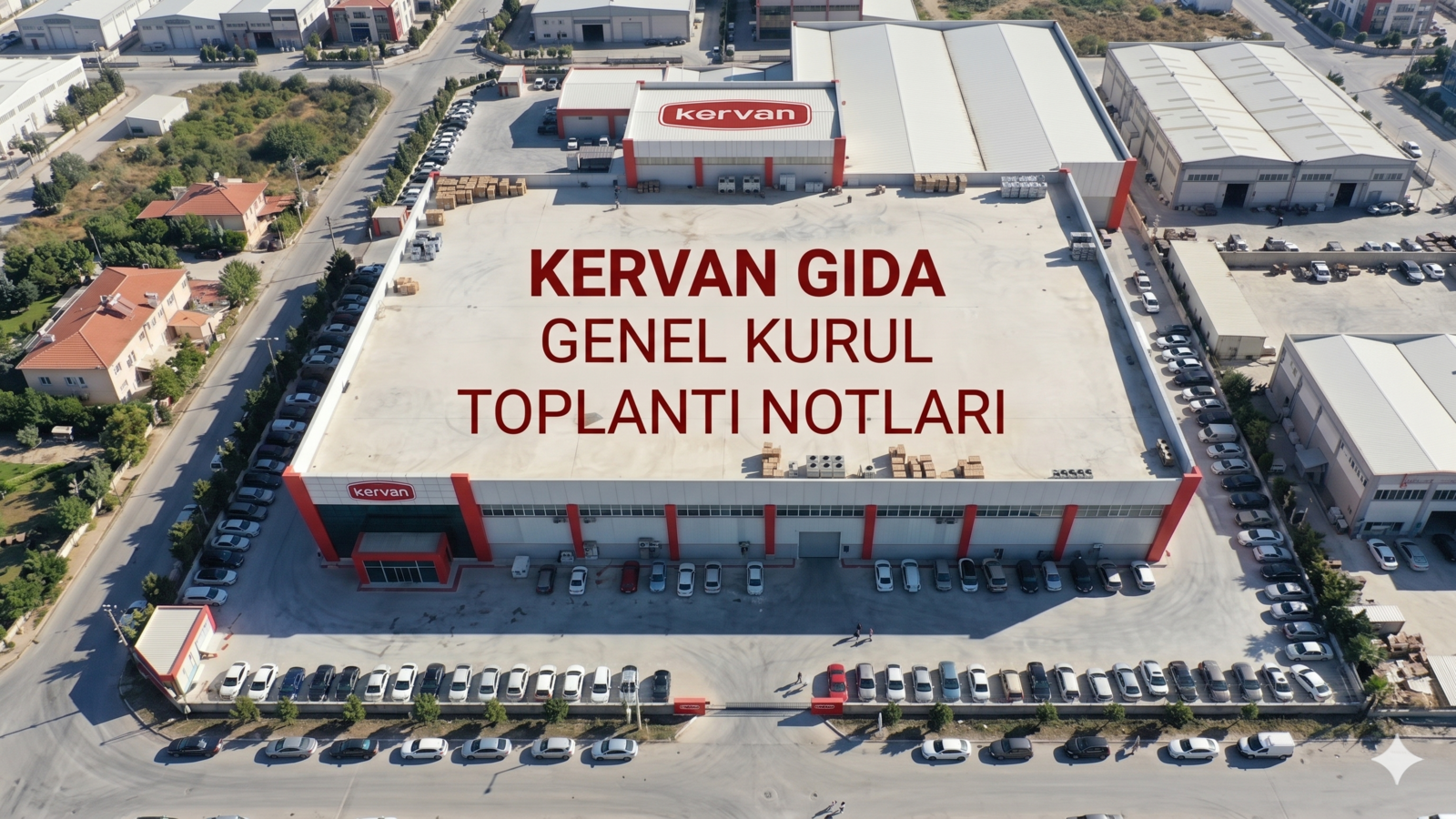
I attended the Annual General Meeting of Kervan Gıda Sanayi ve Ticaret A.Ş. electronically. Even though I am not an investor, I regularly try to follow the general meetings of companies whose operations I am curious about, even if it is in a digital format.
My primary goal at a company’s general meeting is not to review financial data; after all, we can already easily access those via KAP (Public Disclosure Platform). My real focus centers on two main areas: “company quality” and “growth mindset.” I select my notes from the meeting based on details that support these two concepts.
## Company Quality and First Impressions
Unfortunately, my first impression of the meeting was quite negative; the setup was rather careless. Two tables were pushed together, and 8 to 10 people were packed like sardines into this cramped space. A company doesn’t just manufacture and sell products; it also markets its corporate identity. Regrettably, the picture I’m describing did not reflect well on the company’s corporate perception. On top of that, there were numerous technical glitches, such as microphones failing and speakers being unfamiliar with using them. For instance, I couldn’t hear the people who took the floor at all due to the faulty microphones. If you are thinking, “Why make a fuss about this? Is what you will hear there really that vital?”—even if the situation isn’t critical, this lack of care is a clear indicator that they hadn’t prepared for the meeting at all.
Another thing that caught my attention was that the texts published on KAP were read straight from the screen without any presentation slides being prepared. Today, when we can easily transform texts into visual presentations using AI models, they could have at least opted for a method like that.
Let me open a quick parenthesis here to share a personal view: I don’t see a company’s public offering merely as a tool to raise funds. Going public means becoming partners with thousands of people and establishing a transparent relationship with them. Moving forward with this awareness, one must act by considering the interests of all partners.
Closing the parenthesis and moving on; this annual event held by the company is the most important platform where it can directly connect with its investors and partners. Therefore, the care management shows for this event is a direct reflection of the value they place on their investors. I can say that, unfortunately, the company failed the test when it comes to meeting organization and corporate quality.
## Growth Potential and Operational Structure
When it comes to growth, let me give you the bottom line first: I liked the company’s growth structure. The work they do, the geographies they operate in, their growth strategies, and their approach to mitigating negative impacts all point to a management team that knows its business. However, I have a critical note to self here: these statements from management do not offer us 100% certainty. If I am going to invest based on what they say, I need to thoroughly research the background of the shared information to verify its accuracy.
It’s worth elaborating on this point; sometimes I can be a bit convoluted when conveying my thoughts, and I end up clarifying misunderstandings later. I don’t think the company is currently in a revenue growth trend; rather, I want to emphasize that thanks to their business model, they have strong growth potential for the future and could enter such a trend.
## Highlights from the General Meeting
* **Energy Structure:** At the company’s facilities in Turkey—one of the three countries where it manufactures—the entire energy demand is met by its own renewable energy production plants. This rate stands at 5% for the facilities in Egypt, and there are plans to increase it, but no information was shared regarding the Polish operations.
* **Donation Policy:** 90% of the company’s donations go to three well-known major state institutions. The point to watch here is that the upper limit for donations has been set at a maximum of 2% of the consolidated operating profit. Based on the 2025 financials, we calculate this limit to be approximately 23 million TL.
* **The US Market:** This was one of the parts that most whetted my appetite. The company purchased a new warehouse in the US, bringing its total warehouse capacity to 8,300 square meters. Around $17-18 million was spent on this acquisition, and about 80% of this amount was covered via a mortgage. As the presenter noted, there are plenty of financial opportunities in the US. While the expected revenue from the US market this year is around $60-62 million, a major portion of this amount is projected to come from Walmart. Most of the US sales are made to Walmart, and the American office has been actively operating for 13 years.
* **Egyptian Operations:** Another area I found valuable was the operations in Egypt. They have reached an annual production capacity of 10,000 tons and a monthly revenue of $1.5 million. In Egypt, there is intense demand not just for exports but also for domestic market sales. Although the current ratio stands at 60% exports and 40% domestic sales, this balance is projected to level out at 50-50 in the coming period.
* **2026 Expectations:** Within the scope of general company operations, it was noted that some sales regions could not be reached or sales declined due to the war. For this reason, the expectations for 2026 are not expected to be fully realized; it is estimated that they will fall slightly short of the targets.
### Overall Assessment and Next Steps
Coming to my overall assessment, I would first like to remind you that I am just an ordinary person. For this reason, I want to emphasize in bold letters that everyone should conduct their own research and make their own investment decisions.
The company needs to take steps to improve its corporate quality with very minor touches. Let me explain why I focus so much on this topic: “A person can adopt any philosophy as their principle, but only actions reveal true intentions.” I see companies as living organisms. Since the management team is the brain of this organism, being able to anticipate their moves is the biggest factor on the path to finding the right investment.
Based on my impressions from this general meeting, I feel that the company does not value its partners enough. A classic “boss mentality” seems to dominate management: I sense an approach along the lines of, “I took the company public for the funds, if I’m growing the company I’m doing it for the money, and I’m only doing this presentation because I’m forced to.” I want to keep this in the back of my mind when making investment decisions. I’ve summarized the topic broadly, but this is a philosophical issue deep enough to merit a more detailed post in the future.
The company’s financials are generally positive, and its strategic steps for the future look quite solid. Here are the headings I’ve noted down in my ledger to examine deeply in the coming period:
* Gaining a detailed understanding of their scope of operations
* Examining the cost structure
* Conducting country-based scaling analyses
* Learning the manufactured product range and scaling them as well
* Measuring the sectoral impacts of appetite suppressants
* Making long-term projections regarding regulations
Since they have an export-heavy sales structure, I think the most challenging part of analyzing this company will be the need to evaluate target countries based on their cultural dynamics. In my opinion, the food sector is at the forefront of industries with the tightest bonds to consumption cultures.
LEGAL DISCLAIMER: This content does not constitute investment advisory services. Investment advisory is a personalized service tailored to an individual’s risk-return profile, financial situation, and investment goals. The information, comments, and evaluations contained herein are prepared solely for general informational purposes and do not in any way constitute guidance for investment decisions. This content may not be suitable for the reader’s financial structure and risk-return preferences; therefore, investing based solely on this information may not yield the expected results.