
Journey into the Foundation Universe 🚀
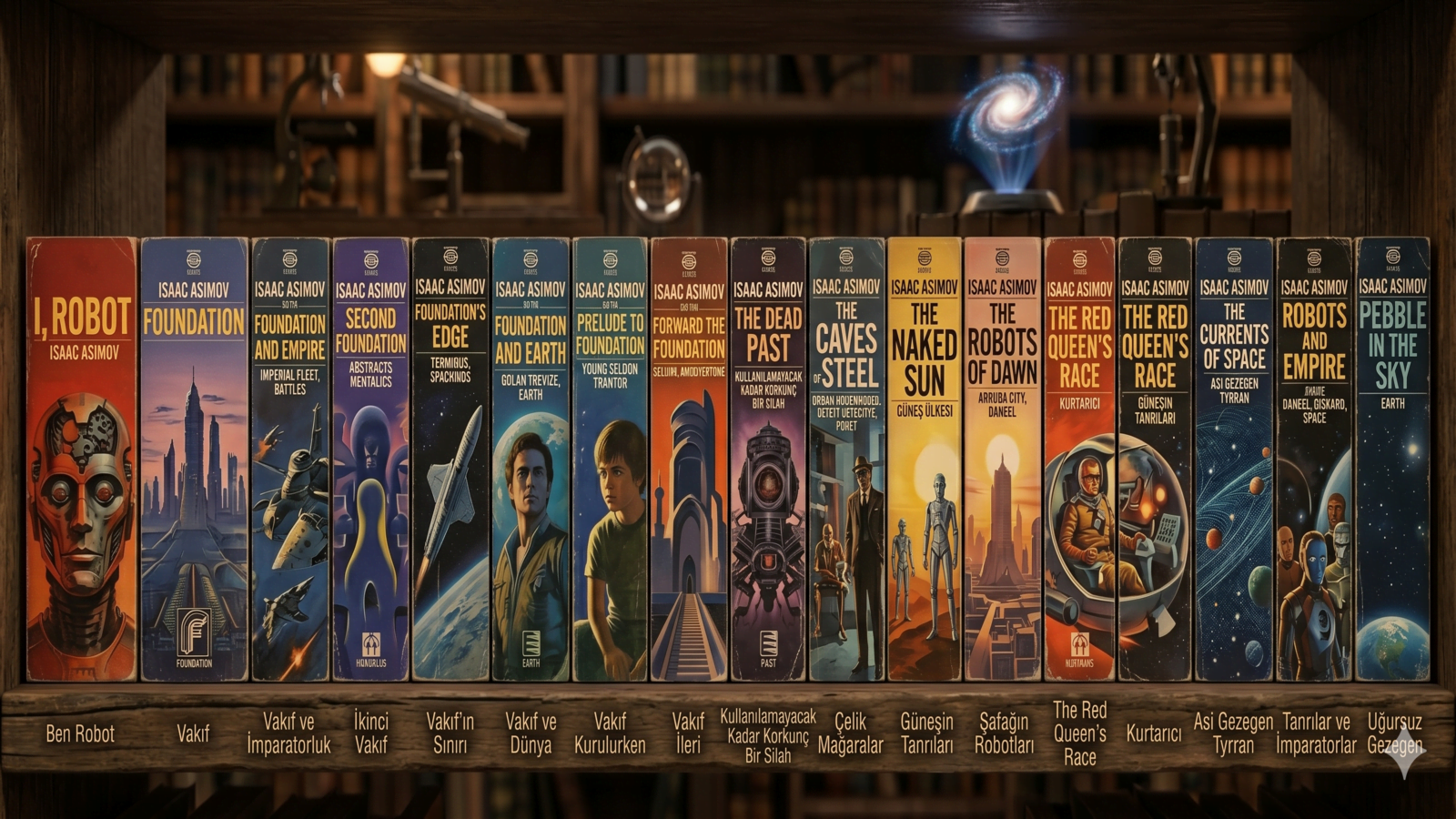
This was a series I had wanted to read for years. I decided to dive into not just the core seven books, but everything I could find related to the “Foundation universe.” Telling myself, “I’m finally going to do this during the nine-day holiday,” I gathered all the books. A total of 16 different books spanning three separate sub-series and an essay… 📚 I hadn’t pushed myself this hard since my university days. Back then, being in an academic environment made getting into a reading groove easy; but amidst today’s hectic daily hustle, this became quite a demanding challenge.
This journey, which began in 1950 with the book *I, Robot*, contains technological predictions that were truly groundbreaking for their time. Since these books have been summarized thousands of times over the last 75 years, instead of providing extensive plot breakdowns for each one, I wanted to touch upon them briefly and focus more on how they made me feel. If you love science fiction and adventure, and if you are looking for a straightforward narrative with a small cast of characters driven by fast-paced plots rather than deep character studies, this series is for you. Every time I finished a book, I eagerly flipped to the next one, completely hooked.
Maybe I should have mentioned this right at the start: if it weren’t for the *Foundation* series on Apple TV+, this massive universe would have just remained something I only knew from a distance. I’m so glad I watched it; otherwise, I would have missed out on such a masterpiece. I loved the show so much that I watched it twice, and I still check its IMDb page every now and then to see when the new season is coming (https://www.imdb.com/title/tt0804484/). 🎬 The imperial grandeur and advanced technologies in the show, combined with modern CGI (Computer Generated Imagery), deliver an incredibly satisfying visual feast.
The storyline’s flow varies depending on whether you follow the chronological order of events or the publication dates of the books. In other words, tracking the plot chronologically requires a completely different roadmap than reading them in the order they were published. Having finished the entire collection, I realized that the reading order I chose was actually the most enjoyable one. So, in this post, I want to briefly touch upon each book based on the exact path I followed.
The Foundation Series
Foundation
In this book, we are introduced to a field of science called ‘Psychohistory,’ which allows for the large-scale prediction of the future. This science gives humanity a chance to shape tomorrow, even if indirectly. I have always had a soft spot for narratives that blend topical issues with futuristic themes; when Asimov weaves this into a story with his smooth and straightforward prose, it ticks every single box for me. As you grasp the vision of Hari Seldon, the founder of this science, you understand much better how the Foundation system evolved into a dogma and a belief system over time, and all the pieces fall into place.
Hari Seldon essentially says: “I have seen the future; this massive 10,000-year-old imperial structure will inevitably collapse, and a 30,000-year dark age awaits us. To prevent this, you must follow my plan.” What truly fascinates me about the story is this: the collapse is unstoppable; no matter what you do, that dark age is coming. Seldon’s unwavering, confident stance—declaring, “We cannot prevent the collapse, but if you do as I say, we can shorten the duration of this dark age”—made me an instant fan of the character. Reading about his visionary steps without catching a breath is an absolute joy. Of course, these plans are not the kind the Empire would ever appreciate; then again, without that conflict, this magnificent universe wouldn’t exist in the first place.
Foundation and Empire
It was in this book that I truly discovered the unique imagination that made me say, “I absolutely must read every single Asimov book.” The author doesn’t get bogged down in a single plotline or character; instead, he keeps the reader entirely gripped by introducing completely different minds. Especially through the character of The Mule, who takes the stage after Hari Seldon, he maps out all the power dynamics in the universe with crystal clarity. This masterful storytelling makes it much easier to wrap your head around the complex galactic structure. This writing philosophy, which goes beyond mere storytelling to offer a sociological lesson, elevates the joy of reading to a whole new level.
Second Foundation
Just as I was wondering, “Is the story going to revolve around this character now?” being introduced to the existence of a second Foundation hit me with a shocking plot twist masterfully pulled off by Asimov. 👋 The universe expands with such clarity and magnificent order that while reading, I sometimes forgot which book I was on, the scale of the empire, or even psychohistory itself. Getting a glimpse into the background efforts of social engineering and the veiled aspects of artificial intelligence multiplied my reading enthusiasm, leaving me wondering, “Will they dive even deeper into these themes later on?”
Foundation’s Edge
While watching the show, I sometimes wondered if they had strayed too far from the main focus; however, reading *Foundation’s Edge* made me realize that this was a deliberate piece of narrative engineering. The constantly changing characters, along with their internal growth and conflicts, briefly pull us away from the core objective—the idea of redesigning the future. This storytelling style makes you realize that a massive span of time is ticking away in the background without us noticing, constantly prompting the question: “When did we lose track of time?”
This temporal layer that occupied my mind throughout the book reminded me of a very familiar dilemma: the eternal conflict between the necessity of investing today for future financial freedom and the desire to “live in the moment,” knowing that time slips away ruthlessly. This philosophical reflection stayed with me until the very last page.
Foundation and Earth
Considering how many works in today’s pop culture are directly inspired by Asimov—and how even those who followed his path inspired subsequent generations—predicting the plot can sometimes become quite easy. Whenever we see a trace of Earth in the book, the idea of “we will find Earth, and we must search for it” inevitably sparks in our minds. 🌍 Right at this juncture, we encounter the concept of a mastermind, though not yet explicitly named, and the true genius behind this grand plan: our iconic robot, R. Daneel Olivaw. Having consumed so much modern sci-fi, cracking this mystery wasn’t hard for me. What truly surprised me—and honestly, what I should have foreseen—was realizing just how deep we would dive into this robot’s backstory in the subsequent books. 🤖
Prelude to Foundation
We only realize that the main story was left incomplete with *Foundation’s Edge* once we step into this book. It might sound a bit contradictory, but as you turn the pages, you understand exactly what I mean. That sense of cosmic expansion I so admired completely captivated me for the first time in this work. By going back in time chronologically, we rebuild the origins and growth of those wonderful characters who suddenly exit the stage in later books, right alongside them from the very beginning. As a result, the religious and political critiques forming the bedrock of the series finally find solid ground.
Forward the Foundation
The first thing that crossed my mind when I finished the book was that this grand mission had been successfully completed on Asimov’s part. As I mentioned, there are many different reading combinations for this massive collection. If you start with *Prelude to Foundation* and *Forward the Foundation* before moving to the main series, you can follow the process of rebuilding society under the guidance of psychohistory in a flawless logical sequence. On the route I followed, however, you find yourself tossed through time and rushing from one adventure to the next alongside the characters. Yet, you conclude the journey at such a satisfying point that you close the cover with a deep sense of literary fulfillment. At least, that was exactly the effect it had on me.
The Robot Series
I, Robot
This was the book I connected with the most out of the entire universe. Objectively speaking, it was the simplest in terms of plot and perhaps the most modest in literary depth compared to the others. However, the fact that it takes place in a period very close to our present day, combined with witnessing the birth of it all, left a completely unique aftertaste, especially after finishing the *Foundation* series.
Our adventure is established on the Three Laws of Robotics, which everyone has heard a thousand times:
- A robot may not injure a human being or, through inaction, allow a human being to come to harm.
- A robot must obey the orders given it by human beings except where such orders would conflict with the First Law.
- A robot must protect its own existence as long as such protection does not conflict with the First or Second Law.
There is a question that many popular works (shows, movies, or books) based on these three laws either ignore or treat superficially: “What if the seemingly unshakeable framework of these laws is actually an illusion?” I am sure you, like me, have thought about this countless times. Turns out, there was no need to worry; Asimov had planned this down to the smallest detail. In the subsequent books, he not only grounds these loopholes logically but also anchors the entire plot—which we thought was built on psychohistory—firmly upon this philosophical foundation. Confronted with this genius, I felt like I had received a mental slap from Asimov. Of course, I only pieced this big picture together as I read the later books, because while turning the pages of *I, Robot*, I was still drifting in the mesmerizing dreams of psychohistory. :)
The Caves of Steel
Unlike the complex temporal leaps of the *Foundation* series, the plot in this book follows a much more linear path. We have a single main character who accompanies us almost until the very end of the series, and the narrative flows through a detective case characteristic of that era. Yet beneath this mystery shell, we witness an empire rising with the help of technology, AI, and robotics, alongside a portrait of humanity depicted almost as a sterilized ‘master race.’ Even though a flawless social order seems to have been established, what Asimov whispers between the lines is quite different. It might be a bit of a stretch, but I think the author wants to emphasize that the true value making us human is our flawed, unpredictable, and entirely unique nature.
The Naked Sun
While reading the book, the famous animated movie WALL-E (https://www.imdb.com/title/tt0910970/) kept popping into my mind. That world, where humans reach extreme levels of comfort and all production is handled by robots, was highly likely inspired by this series. (While on the subject, WALL-E and the relatively recent movie Up (https://www.imdb.com/title/tt1049413/) are always the top two on my list of animations to watch with kids).
Although it isn’t set too far ahead of the first book chronologically, we get a much clearer grasp of the universe’s technology in this work. Asimov depicts a virtual ‘artificial paradise’ where no human has to think about labor, production, or basic economic worries, and where every need is met by robots. Reading about this sterile setup makes it impossible not to ponder humanity’s potential future laziness and alienation, leaving you wondering, “Is this what will become of us?” 🏙️
The Robots of Dawn
While reading this one, another movie played out in my mind. Encountering the milestones of modern cinema within Asimov’s works is truly a fascinating experience. The movie Her (https://www.imdb.com/title/tt1798709/), which centers on humans forming deep, even marital relationships with their personal artificial intelligence, was a magnificent piece of cinema that accurately foresaw today’s digital loneliness all the way back in 2013. *The Robots of Dawn* focuses precisely on this theme; we read about advanced emotional bonds like affection, love, and even marriage being forged between humans and robots, moving far beyond a purely mechanical working relationship.
Frankly, I don’t want to delve too deeply into the plots of this and the previous book. Because once you strip away the powerful sci-fi backdrop and the world-building details, they aren’t fundamentally all that different from classic detective formulas. That’s why I want to turn my focus to the final book of the series, which absolutely mesmerized me.
Robots and Empire
It might be a bold claim, but I believe the initial seeds of the Hari Seldon figure we admired in the *Foundation* series, along with that famous religion-politics dynamic, were actually planted in this book. The process might seem complex at first glance: the universe’s pivotal character, R. Daneel Olivaw, personally witnesses his former human partner, Elijah Baley, gradually transform into a legendary and religious figure within collective memory. Centuries later, when the galactic empire is established and the steps for psychohistory are set in motion, Daneel applies this social engineering experience gained from Elijah to Hari Seldon—assigning him a similar mission to create a legendary figure who will lead the masses.
On top of that, this book introduces us to the philosophy of the famous ‘Zeroth Law’ (A robot may not harm humanity, or, by inaction, allow humanity to come to harm), which stretches the boundaries of the Three Laws of Robotics. Moving at a breakneck pace—spanning everything from the mind-reading capabilities of robots to the nuclear destruction of Earth, and from humanity’s expansion across the galaxy to the quest for a new order—this work tightly binds the two major series together, fitting the most critical missing puzzle piece into place.
The Empire Series
The Stars, Like Dust, The Currents of Space, Pebble in the Sky
To be honest, even though these three works are set in the same macro-universe, feature similar technological elements, and connect indirectly to the broader lore, they ultimately feel like side stories. While they are highly enjoyable to read, I must admit they pale slightly in comparison to the other masterpieces that set the bar sky-high. Although I felt a slight tinge of melancholy when finishing them, the unparalleled sense of satisfaction from completing the entire Asimov universe cover-to-cover was priceless. Because of that, every single one of them easily earned a passing grade from me.
Overall :)
Instead of plot summaries, I wanted to talk about what I found within these books. Reading about the technological evolution of humanity and visualizing it was the biggest catalyst for me. I didn’t even have to wonder what would happen if an empire spanned the entire galaxy rather than just a tiny planet like Earth, because I got to experience both its rise and fall right alongside Asimov. Knowing these works were written in the 1950s, comparing the predicted technologies with today’s AI advancements was so much fun that if I had the time, I would absolutely read them all over again. When I first cracked open the series, I thought I was just getting into sci-fi and adventure; however, the elegant touches spanning history, philosophy, religion, and sociology are exactly what elevates the series from standard fiction to the status of a true masterpiece.
Penning these lines a month after finishing my reading, not much remains in my mind beyond the powerful emotions the books left behind. Perhaps I could have written pages upon pages while the experience was fresh, but looking back years from now, this will certainly be enough.
It actually crossed my mind while writing this post: I want to write a separate piece about the differences between the *Foundation* show and the books. Since the universe is so vast and the books are so numerous, I noticed plenty of discrepancies while reading. There were even parts that left me completely shocked, and we’ve done nothing but praise Asimov for it… ✍️