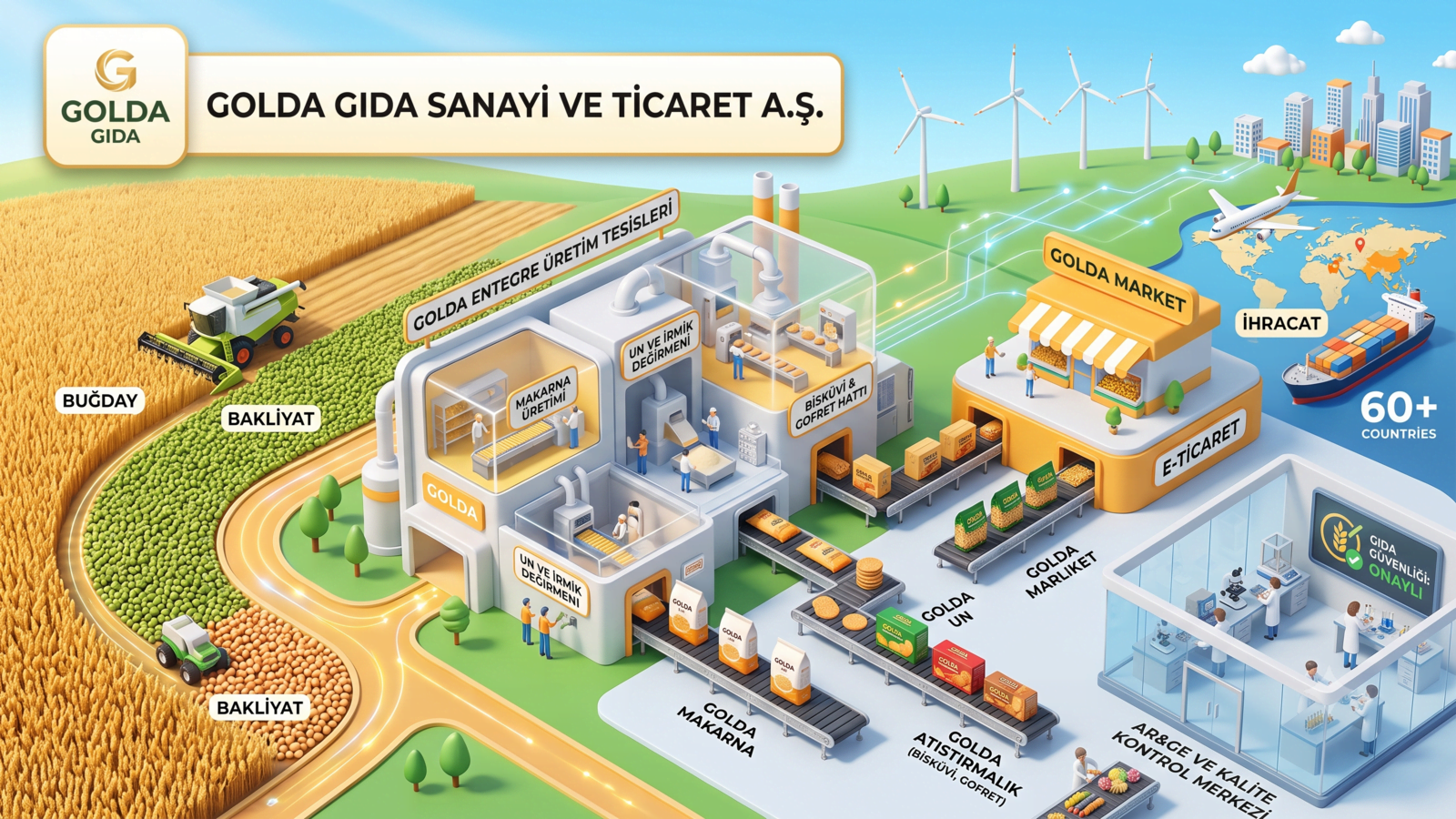
# Golda IPO Review
Rather than rehashing the basic IPO information that anyone can easily find, I wanted to use this review to break down Golda’s IPO structure, the logic behind the secondary offering, their use of proceeds, debt levels, and operational growth potential from an investor’s perspective.
## IPO Structure and Secondary Offering
The company currently operates as a partnership between Bera Holding A.Ş. (66.00%) and Konya Kağıt San. ve Tic. A.Ş. (34.00%). In the IPO process, 50 million lots will be issued through a capital increase, while 37.5 million lots will be offered through a secondary sale by existing shareholders.
At first glance, the heavy secondary offering by the main shareholder, Bera Holding, and the resulting free float rate reaching 35% were the first things that caught my attention, leaving a negative initial impression. As I always say, if a company is profitable or has strong future growth prospects, it raises questions when a rational partner reduces their stake so significantly. This initially brought the net cash flowing directly into the company’s coffers down to around 423 million TL. To be honest, at this stage of my analysis, I thought this was an IPO model designed purely for the majority shareholder to cash out and exit.
However, looking deeper into the balance sheet and debt structure changed my mind. It appears that Bera Holding will inject the cash proceeds from this secondary sale back into Golda. Once that happens, roughly **800 million TL** will enter the company’s coffers. Considering the scale of the company, this amount could have a highly positive impact on both funding new investments and easing cash flow. Consequently, the majority shareholder’s sale no longer concerns me as much as it did initially; instead, it suggests that rather than offloading a financially strained or risky asset, the company is leveraging the IPO opportunity with a focus on investment.
For price stabilization operations, a 30-day window has been set, with 20% of the gross IPO proceeds allocated for this purpose. While the percentage looks quite good on paper, keeping in mind the net cash that will actually remain with the company post-IPO, the remaining funds available for this support might turn out to be somewhat limited.
## Use of Proceeds and Cash Needs
The planned allocation of the IPO proceeds is as follows:
* **50-60%** — Capacity expansion and modernization
* **40-50%** — Working capital
Another detail that caught my eye here is the 10% discrepancy when adding up the lower and upper bounds. This gives the impression that the company hasn’t established a clear vision regarding how it will spend the capital or what exactly it needs.
## Operational Structure and Growth Potential
Looking at the company’s income statement data (as of year-end 2025), the breakdown of the 2,616,586,065 TL in total gross sales revenue is as follows:
* **Domestic Sales:** 2,053,452,737 TL (78.5%)
* **International Sales:** 563,133.328 TL (21.5%)
On an income statement basis, the share of product groups within total revenue shifted over the periods as follows:
| Product Group | 2025 Share (%) | Q1 2026 Share (%) |
| Pasta | 62.3% | 50.4% |
| Commercial Sales | 6.8% | 17.2% |
| Flour | 12.9% | 11.7% |
| By-products | 9.5% | 9.6% |
| Biscuits | 7.1% | 7.5% |
| Pulses | 2.6% | 4.8% |
| Semolina | 0.6% | 0.8% |
There is a downward trend in overall sales volume over the years, but the company has managed to scale down costs proportionally. General administrative expenses show a slight increase, while marketing and sales expenses reflect a small decline. Due to this balance, operating profit has also ticked down over the years in line with revenue. From this, we can anticipate that any future boost in revenue will lift operating profit right along with it.
The company has continued to generate real earnings by maintaining its flat trajectory under current economic policies, which is quite positive. However, it’s worth noting that no clear progress has been made on the growth front. For valuation purposes, I am basing my numbers on a 2025 net profit of **282 million TL**—which normally sits around 19 million TL but reaches this figure once the effect of adjusting for net monetary position losses is factored in.
## Debt, Receivables, and Cash Cycle
The current assets line on the company’s latest balance sheet opens with 533 million TL in cash assets, which looks exceptionally positive given its scale. Looking at the trade receivables-payables balance, there are 250 million TL in trade receivables against 150 million TL in trade payables. The collection period for receivables stands at 33 days, while the payable days are at 23 days. Though there is a slight maturity mismatch, considering the net difference between receivables and payables and a sales model that ensures continuous cash conversion, risks here appear quite low for now. In a business model with such continuous turnover, inventory levels around 270 million TL can also be considered reasonable; in fact, the year-over-year decline in inventory runs parallel to the drop in revenue.
On the debt side, having wiped out legacy short-term financial debt is a massive advantage. Aside from trade payables, there is no heavy debt burden to strain the company. Almost all long-term liabilities consist of deferred tax liabilities. Since this line item takes up a significant chunk relative to the company’s scale, I looked into it and found that it stems primarily from a technical tax effect due to the revaluation of tangible assets and investment properties. Since these fixed assets won’t trigger a direct cash outflow unless they are sold or depreciated as expenses, we can say the company is effectively **debt-free** in terms of net financial debt.
Thanks to this debt-free structure, the company’s financial expenses from banking transactions remained at just 18 million TL, while its financial income reached 225 million TL. This financial balance clearly presents a very positive outlook.
## Capacity, Investments, and the Outlook
The company’s capacity utilization rates by product group have trended as follows:
| Product Group | 2023 | 2024 | 2025 | 31.03.2026 |
| Pasta | 77.2% | 80.2% | 78.6% | 77.9% |
| Flour | 81.5% | 84.8% | 83.7% | 84.1% |
| Biscuits | 70.1% | 72.3% | 73.9% | 71.5% |
| Pulses | 62.4% | 65.0% | 67.2% | 66.8% |
| Halva Semolina | 68.9% | 71.1% | 72.5% | 70.3% |
Analyzing these figures shows us that market demand has hit a saturation point for the company, which is far from operating at full capacity. Therefore, I suspect the 50-60% allocation in the IPO use of proceeds report will go toward modernizing existing facilities and boosting efficiency, rather than creating brand-new capacity.
The details of the planned investments are outlined as follows:
* **Pasta Production Line:** In addition to current capacity, investments will be made in a new spaghetti line, 2 packaging machines, robotic and wrapping systems, a boiler room, and a vacuum room compressor.
* **Semolina Line:** A process revision will be carried out on the semolina mill (which has a daily capacity of 250 tons), and 1 vacuum semolina packaging machine will be purchased.
* **Pulses Department:** New silos with a capacity of 4x1,500 tons will be constructed for product storage.
* **Biscuit Line:** Investments in a depositor and packaging automation, alongside quality and yield-enhancing improvements, will be implemented on line number 2.
For now, I remain neutral regarding the company’s overall operational setup and business continuity strength. There is an ongoing sales flow, but the shrinking volumes give the impression that keeping it up is a bit of a struggle. Factor in the sizable secondary offering lingering in the back of my mind, and I prefer to maintain a cautious stance.
## Overall Assessment
To sum up, Golda has a self-sustaining, profitable operational structure with relatively low financial risk. However, considering its value add and growth rate, I don’t think it promises immense value for long-term investors (which in my own strategy means horizons exceeding 3-4 years) just yet. Since my investment style leans toward short-to-medium-term cycles (between 1.5 and 3 years), Golda looks like a solid company that could offer cyclical opportunities during this window and well deserves a spot on the watchlist.
Because it’s small-scale, managing to boost revenue by even 25% down the line could translate into a substantial gross injection of 80-90 million TL into net profit. The fact that the company has shaken off its legacy baggage, boasts a net debt near zero, and will fund these investments using the IPO proceeds could provide excellent maneuvering room over the next few years of a medium-term horizon.
## Additional Points to Keep an Eye On
* The stance of the two major shareholders and whether they will continue to sell shares at the end of the first year post-IPO.
* The impact of inflation rates, tight monetary policy, and potential exchange rate fluctuations on demand in the staple food sectors where the company operates.
* Trends in wheat raw material costs, which directly impact a massive chunk of revenue and serve as the main input for almost all products.
* The timeline for modernization investments that will boost capacity, particularly on the pasta side, and when these investments will wrap up and start reflecting on the financial statements.
* How the 40-50% allocation for working capital will be utilized across financial instruments (Since this is a debt-free company, investor relations could be asked whether this capital will be held purely to generate financial income or shifted to alternative areas like investment property).
* The local competitive dynamics of the Turkish pasta industry and the extent to which the company can scale up its international sales volume.
LEGAL DISCLAIMER: This content does not constitute investment advisory services. Investment advisory is a personalized service tailored to an individual’s risk-return profile, financial situation, and investment goals. The information, comments, and evaluations contained herein are prepared solely for general informational purposes and do not in any way constitute guidance for investment decisions. This content may not be suitable for the reader’s financial structure and risk-return preferences; therefore, investing based solely on this information may not yield the expected results.