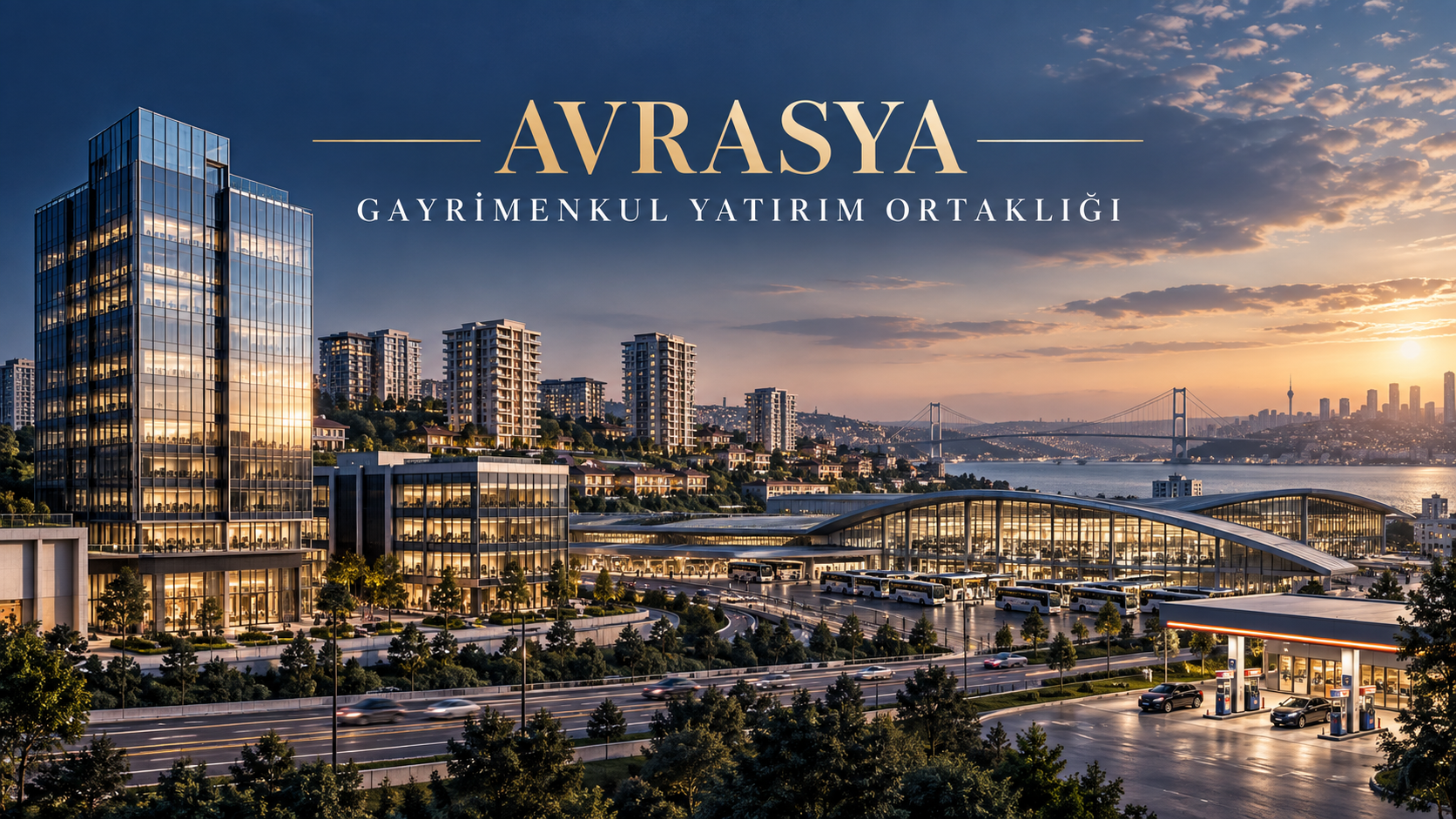
As I do with every company, I’d like to start by understanding the company’s business model and how it makes money. Avrasya Real Estate Investment Trust’s (Avrasya REIT) revenue structure can broadly be divided into two categories: recurring rental income and periodic real estate sales income. The company’s primary assets generating regular rental income are as follows:
- Samsun Intercity Bus Terminal
- 2 gas stations within the terminal
- Çarşamba Bus Terminal
- Havza Bus Terminal
- Ticket sales offices at Tarsus Bus Terminal
- Istanbul Levent Metrocity Business Center, Block A, 17th floor
- Istanbul Levent Metrocity Business Center, Block C, 5th floor
Real estate sales, on the other hand, allow the company to generate high revenue in certain periods. For example, in 2024, real estate sales exceeded 182 million TRY. In my view, however, rental income and real estate sales income must be kept separate. While rental income allows the company to generate regular and repeatable income from its assets, real estate sales mostly create one-off gains. If Avrasya REIT were a real estate development company constantly building new projects and offering them for sale upon completion, it would be reasonable to treat sales revenue as a natural part of its business model. But since I don’t see such a continuous development and sales cycle in its current structure, I don’t find it appropriate to include these large sums from real estate sales in the company’s sustainable annual earning power.
Therefore, when evaluating the company’s true operational strength, the main factors for me are the level of rental income, how much this income can grow over time, and the long-term quality of the income-generating assets. One notable recent transaction was the company’s exit from its Joy Hotel investment in Georgia. Although this sale, amounting to roughly 466 million TRY, might appear to create significant resources for the company at first glance, evaluating it solely on the sale price is not enough given the payment structure and maturity terms.
Annual Report and Real Estate Portfolio
When I reviewed the company’s latest annual report, one of the first things that caught my attention was the quality of reporting. Frankly, I would expect a more comprehensive annual report from a company with nearly 30 years of stock market history whose primary assets consist of real estate. The report contains visuals of the properties, but even basic details such as when those photos were taken are unclear. In addition, there are sections that use phrasing almost identical to previous period reports. I do not see a narrative that gives investors a sufficient sense of the company’s future strategy, portfolio management philosophy, rationale behind its investments, or the long-term potential of its existing assets. To me, a REIT’s annual report should not simply list the properties it owns; it should also explain why management holds these assets, where it intends to grow, which investments it may exit, and how it plans to deploy capital in the coming years.
The company’s real estate portfolio is as follows:
- Yusuf Ziya Yılmaz Samsun Intercity Bus Terminal
- Samsun İlkadım 2 gas stations
- Samsun Çarşamba Bus Terminal
- Samsun-Havza Bus Terminal
- Istanbul Metrocity, Block 17, Independent Section No. 187
- Antalya/Alanya D-1, D-3, and R3 residential units
- Istanbul Arnavutköy Deliyunus Village, Türkmen Cemetery location, land plots No. 261 and 944
- Metrocity Block C, 5th Floor, Apartment 316
- School building and land plot in Samsun Çarşamba Kirazlıkçay Neighborhood
- Masonry apartment building in Ankara Yenimahalle
- 4 duplex ticket sales offices at Tarsus Intercity Terminal
- Edirne Central, land plots No. 14, 16, and 17
It is clear that properties in and around Samsun form the foundation of the portfolio. In later years, real estate from different cities with quite diverse characteristics was added. My criticism here is not that the company purchases real estate across different cities in Turkey. As long as the price is right and opportunities arise, investing in different regions can certainly make sense. What I really question is whether there is a clearly defined investment strategy behind this portfolio. On one side, there are bus terminals and gas stations; on the other, apartments, a school building, office spaces, residential units, and land plots. Looking at the portfolio as a whole, it is difficult to see the company specializing in a specific real estate segment or acting in line with a focused rental yield and growth target.
This does not inherently mean the portfolio is bad, but it makes it difficult for investors to understand the logic behind how capital is allocated. In particular, the future economic potential of the bus terminal assets, which make up a significant portion of the company’s regular rental income, is a topic that requires separate evaluation. In real estate investing, I believe you should not look only at current rental income; you also need to consider how much demand the asset may command in 10 or 20 years, how its region will develop, and what alternative usage options exist. From this perspective, the current portfolio structure does not make a strong first impression for my investment philosophy.
Ownership Structure and Capital Movements
The company’s ownership structure is as follows:
- Metro Avrasya Inv. Georgia A.Ş.: 25,482,499 TRY (22.83%)
- Aytu Tuna: 20,000,000 TRY (17.92%)
- Barlas Ünal: 5,995,548 TRY (5.37%)
- Metro Menkul Değerler A.Ş.: 5,736,992 TRY (5.14%)
- Metro Portföy Yönetimi A.Ş.: 5,525,352 TRY (4.95%)
- Galip Öztürk: 5,425,000 TRY (4.86%)
- Efestur Turizm Yatırımları A.Ş.: 5,114,120 TRY (4.58%)
- Avrasya GYO A.Ş.: 3,730,613 TRY (3.34%)
- Other: 34,589,877 TRY (31.01%)
- Total: 111,600,000 TRY (100%)
Having a stock market history of nearly 30 years could be seen as a positive factor at first glance. A company traded for this long has navigated various economic crises, periods of high and low interest rates, shifts in the real estate market, and different management cycles. This gives investors a broad timeframe over which to evaluate its historical performance. However, when looking at capital movements, a more striking picture emerges. Including the pending transaction, the company’s history includes 6 rights issues and 2 private placements.
I do not view rights issues as inherently negative. When a company identifies a high-return investment opportunity or wants to accelerate growth, requesting fresh capital from shareholders can make sense, and if those funds are deployed correctly, they can create significant long-term value. What matters to me is not simply that a capital increase took place, but how efficiently that capital was used afterward. If we were talking about one or two capital increases, it would make sense to analyze which investments were made and how much value they created. But in a structure where capital increases occur repeatedly, a more fundamental question arises: Can the company generate sufficient cash from its own operations, or does it continually finance its investments and growth by asking shareholders for new capital? In this regard, Avrasya REIT’s track record raises an important question mark for me.
Financial Position and Asset Structure
Moving on to the financials, we see a remarkably low operating expense structure. General administrative expenses stand at around 2.6 million TRY. The headcount also shows that the company does not require a large organization:
- As of December 31, 2024: 6 employees
- As of December 31, 2025: 8 employees
- As of June 30, 2026: 9 employees
For a real estate investment trust, this lean structure can be considered normal. The company does not run a manufacturing or service operation that requires hundreds of employees. Thus, one advantage of this business model is that as long as the properties continue to generate rental income, operations can be sustained with very low overhead. Under current assets, there are financial investments of around 123 million TRY. For a company without high working capital needs, I generally view deploying idle cash into financial instruments as a positive step.
481 Million TRY Receivable from the Georgia Sale
The main standout item within current assets is Other Receivables, amounting to approximately 481 million TRY. This figure represents the receivable arising from the sale of the hotel asset in Georgia. Here, I do not think it is appropriate to treat the 481 million TRY shown on the balance sheet as directly equivalent to having the same amount in cash in the company’s bank account. What matters is not just the size of the receivable, but when that money will be collected, in what currency it is denominated, and at what interest rate it will accrue until collection.
The receivable is structured in Georgian Lari at an annual interest rate of 11%. Considering the level of TRY interest rates in Turkey, this could create a significant opportunity cost. Had the company held this amount in cash today, it could have reduced debt, invested in different financial instruments, or financed new investments under different terms. Therefore, rather than simply saying “the company has a receivable of 481 million TRY,” we need to evaluate the collection timeline, currency, interest rate, and opportunity cost together. Especially in related-party transactions, whether the terms favor the company becomes particularly important to me. If fully collected, the company’s current assets could reach around 654 million TRY. Relative to the company’s current scale, this amount could provide substantial liquidity. However, until the cash is actually available for the company’s use, I do not value this receivable on a one-to-one basis with cash.
Investment Properties
Turning to non-current assets, the topic becomes far more important since we are analyzing a REIT. Virtually all of the company’s non-current assets consist of investment properties. Therefore, if we want to understand the true economic value of Avrasya REIT, we need to look not just at the values at which these properties appear on the balance sheet, but also at whether they genuinely justify those figures.
An appraisal value alone is not enough for me. A property might sit on the balance sheet at a value of 100 million TRY, but if it generates only a few million TRY in annual rent, takes a long time to sell, and is located in a region with limited future economic potential, I would not want to accept that asset at face value during valuation. The reverse is also true. A property in a prime location with steadily rising rental income, strong liquidity, and significant alternative-use potential could be worth more than its book value. Consequently, when evaluating Avrasya REIT’s investment properties, valued at roughly 2.2 billion TRY, rental yield, location, marketability, and future-use potential are just as important to me as the appraisal values.
Liabilities and the Metro Hotel Apartments Project
When looking at the company’s liabilities, the most notable item outside of tax debts is other payables to related parties:
- Short-term other payables: 159 million TRY
- Long-term other payables: 238 million TRY
- Total: 397 million TRY
However, what matters more than the total debt figure is why this debt arose in the first place. A major driver of this borrowing is the Metro Hotel Apartments project planned in Edirne and the related company acquisition. Avrasya REIT acquired a 100% stake in Metro Turizm Otelcilik A.Ş., the owner of the land on which the project is planned, from group company Avrasya Petrol ve Turistik Tesisler Yatırımlar A.Ş. for a total consideration of 530 million TRY.
The payment plan is structured as follows:
- 100 million TRY cash payment
- 253.95 million TRY to be paid on deferred terms until August 31, 2027
- 176.05 million TRY to be settled through the delivery of commercial units to be constructed within the project
In theory, it can be entirely normal for a REIT to incur debt or make a deferred acquisition in order to develop a new project. In fact, if the right project is chosen, such a transaction can significantly increase the company’s future value. However, to assess how successful such an investment may be, one must consider whether the purchase price was fair, what the expected return is, when the project will be completed, how much additional investment will be required, and what kind of burden the financing cost will place on the company.
What I particularly question in this transaction is the timing of capital allocation. Before the receivable from a major prior asset sale has even been converted into cash, capital is once again being tied up in a high-value asset that is not yet producing income. It is certainly possible that the Metro Hotel Apartments project will create significant value in the future, and dismissing that possibility outright would be wrong. However, based on the available information, moving into a large-scale, non-cash-generating project before fully collecting the proceeds from a previous asset sale is not the capital allocation approach I would prefer.
Income Statement and Real Earning Power
Moving to the income statement, the operating structure becomes clearer. In periods without real estate sales, annual revenue stands at around 91 million TRY. Thanks to the low-cost nature of the business model, the gross profit margin reaches an impressive level of roughly 95%. At first glance, a 95% gross margin may look striking, but in company analysis, one has to look not only at the margin itself but also at the scale of revenue on which that margin is generated. Having a 95% gross margin on approximately 90 million TRY in revenue is certainly positive. Yet when weighed against billions of lira in assets and equity, the absolute economic value created remains limited. That is why what matters most to me is how much profit and cash the company can generate relative to the capital it employs. Given Avrasya REIT’s balance sheet scale and equity base, the earnings generated from its core operations remain low in my view.
Looking further down the income statement, we see that Other Operating Income has a significant impact on reported profit. However, a major portion of this income stems from fair value gains on investment properties. I do not ignore these gains; an increase in real estate value is a genuine development that enhances the company’s economic value. But when evaluating operating performance, I do not treat fair value gains in the same way as rental income or cash entering the bank account.
To illustrate with a simple example, suppose I own a plot of land in a prime area of Istanbul valued at 10 million TRY, and a year later its appraised value rises to 15 million TRY. Economically, I am 5 million TRY wealthier, and that is a genuine increase in value. Yet unless I sell the land or generate cash from it in another way, I cannot use that 5 million TRY to pay electricity bills, salaries, or debt obligations. Therefore, real estate appreciation is important for wealth creation, but it is not the same as cash generated from operations. This distinction is especially important for REITs, because reported profit can look quite high thanks to property valuation gains while actual operating cash generation remains weak.
Similarly, the Net Monetary Position Gain/Loss item can heavily affect reported profits during high-inflation periods. My goal here is not to recalculate net profit under accounting standards; it is to understand how much economic gain the company actually produces using its capital. When I strip out property appreciation gains and monetary effects from inflation accounting, I find that the company’s annual operating profitability falls to roughly 0 to 10 million TRY by my calculations. For a company with a market capitalization of around 1.8 billion TRY and equity exceeding 2 billion TRY, this level of profitability is insufficient for me.
Cash Flow Analysis
The overall cash flow picture is as follows:
- Cash flow from operating activities: Negative
- Cash flow from investing activities: Positive
- Cash flow from financing activities: Negative
The key line item for me here is cash generated from operating activities. In the long run, for a company to create value, it is not enough for the appraised value of its properties to rise; its core business model must also generate cash. If a company must continuously sell assets, take on debt, or raise new capital to sustain operations or fund new investments while property values rise, one has to question how efficiently the high asset value on the balance sheet is working for shareholders. This is where one of my core reservations about Avrasya REIT lies. Despite operating with low overhead and enjoying high gross margins, the company fails to generate strong operating cash flow relative to its equity base and real estate portfolio.
Long-Term Outlook for Bus Terminal Assets
Given that bus terminals carry significant weight in the portfolio, I believe their future warrants a separate evaluation. In Turkey, intercity bus transportation has long been a major mode of transit, and bus terminals remain commercial assets that generate regular rental income today. In long-term real estate investing, however, looking only at present conditions is not enough.
The expansion of air travel, the growth of high-speed rail networks, shifting intercity travel habits, developments in private vehicle ownership, and slowing population growth could all affect the future economic value of bus terminals. I am not concluding definitively that bus terminals will lose value; reaching such a conclusion would require far more detailed regional analysis of transportation, demographics, and economic development. But when evaluating a 10- or 20-year real estate investment, I believe structural shifts like these must be factored into the risk assessment.
This becomes even more important given that bus terminal assets in and around Samsun occupy a major place in the portfolio. Potential new railway investments in the region, increased airline usage, or a decline in intercity bus demand could affect both the rental income and economic value of these assets. Therefore, even though they continue to generate income today, it is difficult for me to view bus terminals as real estate assets with high long-term growth potential.
Valuation
Looking at Avrasya REIT’s core business model in theory, we are not talking about a bad structure. In Turkey, where real estate has long served as an important store of value, acquiring income-generating assets, selling appreciated properties when attractive opportunities arise, and redeploying capital into new investments can be a successful strategy. Executed properly, this model can generate steady cash flow, offer some protection against inflation, and create long-term capital gains. My criticism of Avrasya REIT is less about the business model itself and more about how the company executes it.
Looking back at the company’s nearly 30-year stock market history, I struggle to identify a structure in which capital has sustainably generated high returns. The fragmented portfolio, questions surrounding the future economic potential of certain assets, repeated capital increases, extensive related-party transactions, and low operating profitability relative to the existing capital base are the main factors supporting this view.
I believe it is important to avoid the simplistic mindset that “the company owns a lot of real estate, so it must be valuable.” Simply owning real estate does not create value on its own. What matters is how much income those assets generate, how that income develops over time, how easily the assets can be sold when necessary, and how efficiently management reinvests the capital that is released.
At the time of writing, the company trades at a market capitalization of roughly 1.8 billion TRY. With equity standing at around 2.3 billion TRY, one might initially assume that Avrasya REIT trades below book value and could therefore be cheap. Looking strictly at the Price-to-Book ratio, there appears to be a noticeable discount. Under my valuation framework, however, trading below book value does not automatically mean a company is cheap. I first seek to understand the quality of the assets underlying that book value and how much return that capital generates. Having roughly 2.2 billion TRY in investment properties is certainly significant, but the real question for me is how much economic value these assets actually produce for the company and its shareholders.
Three key issues become decisive for me here:
- ROE and ROIC remaining below 1%
- The company’s inability to generate strong and consistent operating cash flow
- Not viewing the entire approximately 2.2 billion TRY of investment properties as having the same economic quality based solely on appraisal values
The fact that ROE and ROIC remain below 1% is particularly important to me. Put simply, the company sits on a very large capital base, yet the return generated on that capital is exceptionally low. When a company holds 2.3 billion TRY in equity but generates only a few million lira in economic earnings, one must question how efficiently capital is being deployed. Naturally, evaluating a REIT solely through traditional industrial profitability metrics would be misleading. Real estate appreciation is also part of economic value. But when viewed alongside weak operating cash flow, these ratios become more significant in my analysis.
Weighing all these factors together, I conclude that Avrasya REIT’s current market price is not cheap in my view. In fact, based on my valuation approach and the current data, I estimate that the company’s market capitalization of roughly 1.8 billion TRY is about 40–45% above what I would consider a fair valuation level.
It would be wrong to view this percentage as a fixed or absolute company valuation. Valuation is not a mathematical exercise with a single correct answer. Actual property sale prices, the future value created by the Metro Hotel Apartments project, the timing and terms of collecting the Georgia receivable, changes in rental income, and future capital allocation decisions by management could all materially alter this assessment. Therefore, the 40–45% range is a personal valuation conclusion reached using the currently available data and my own investment framework.
Overall Assessment and Conclusion
Ultimately, looking at Avrasya REIT, it would not be accurate to say that the company has no positive aspects. Holding substantial real estate assets, operating with low overhead, generating high gross margins from its rental model, having a long stock market history, and holding significant receivables awaiting collection are all noteworthy positives.
On the other hand, the factors carrying more weight in my investment decision are low returns on capital, weak operating cash generation, questions regarding the long-term growth quality of the portfolio, a history of frequent capital increases, extensive related-party transactions, and capital allocation decisions. In particular, the fact that a company with billions of lira in real estate assets and equity generates such modest economic returns from those assets remains the core issue for me.
For this reason, I do not automatically view a company with approximately 2.3 billion TRY in equity trading at a market capitalization of 1.8 billion TRY as an investment opportunity. What matters to me is not how many billions in assets appear on the accounting ledger, but how effectively those assets are working on behalf of shareholders.
Under current conditions, Avrasya REIT does not meet my investment criteria. Should the stock price decline significantly, should the economic potential of the Metro Hotel Apartments project become clearer, should the Georgia receivable be fully collected, or should the company begin shifting its portfolio toward higher-yielding assets, my assessment would naturally change. Looking at the situation today, however, the main question for me is not “How cheap is the stock relative to book value?” but rather “How efficiently is the company’s multi-billion-TRY capital base working for shareholders?” Based on the current data, I cannot answer that question positively.
LEGAL DISCLAIMER: This content does not constitute investment advisory services. Investment advisory is a personalized service provided based on an individual’s risk-return profile, financial standing, and investment objectives. The information, commentary, and assessments provided herein are prepared solely for general informational purposes and should not be construed as investment recommendations or guidance. This content may not align with the reader’s financial position or risk-return preferences; therefore, investing based solely on this information may not yield the expected outcomes.